How to Prepare for a Week Without Power: US and Canada Plan (2026)
Table of Contents
Affiliate disclosure: Some links on this page are affiliate links, including links to Amazon, EcoFlow and BLUETTI. If you buy through them we may earn a commission, at no extra cost to you. As an Amazon Associate we earn from qualifying purchases. This never influences our rankings or verdicts.
To prepare for a week without power, store seven days of water, food and medicine, then plan electricity for the fridge, phones, lights and any medical device. Canada's official minimum is 72 hours and the US government says several days, but real outages run longer. A power station of 2kWh or more, recharged by 400W to 800W of solar panels, keeps those essentials running for the full week.
This guide sets out what each government actually asks for, a seven-day supply list for both countries, a daily power budget built from measured appliance figures, and the power stations that can carry it. If you already know you want a unit, our picks for the best solar generators for emergency preparedness go deeper on each model.
What the US and Canada tell you to prepare for
Canada. Public Safety Canada asks every household to "be prepared to be self-sufficient for at least 72 hours" (Get Prepared emergency kits). That number has not changed: on November 3, 2026, a department spokesperson repeated the 72-hour minimum to CBC News, while Suzanne Bernier of the Disaster Recovery Institute Canada, quoted in the same report, urged at least seven days of supplies (CBC via Radio-Canada International). British Columbia already goes further and asks for a "minimum three-day to one-week supply" of food (PreparedBC).
United States. FEMA's Ready.gov kit list asks for water and "at least a several-day supply of non-perishable food," and warns you may need to get by on your own "for several days." Some states ask for more: Oregon's emergency management office tells residents to be "two weeks ready" (Oregon Health News).
Why plan for a week anyway. The EIA counted an average of 11 hours of interruptions per US customer in 2024, but South Carolina averaged nearly 53 hours after hurricanes Beryl, Helene and Milton, which caused 80% of the year's outage hours (EIA). After Ontario's March 2025 ice storm broke more than 2,700 poles, Hydro One had power back to just over 99.6% of customers two weeks later, so some homes were still waiting (Hydro One update). The official minimum covers an ordinary storm; a week covers a bad one.
Seven-day supply checklist for a two-person home
| Supply | US guidance | Canada guidance | Seven days, two people |
|---|---|---|---|
| Water | One gallon per person per day | About 4 litres per person per day | 14 gallons (about 56 litres) |
| Food | Several days of non-perishables | 72 hours federally; three days to a week in BC | Seven days of food that needs no fridge or stove |
| Medication | Prescription medications | Enough to last a couple of weeks | Two weeks, plus a cooling plan for anything refrigerated |
| Light and news | Flashlight, battery-powered or hand-crank radio | Flashlight, radio, extra batteries | Two flashlights, one radio, spare batteries |
| Phones | Cell phone with chargers and a backup battery | Chargers for your mobile devices | A power station or power banks for a week of charging |
| Cash | Cash or traveler's checks | Enough for basic needs for a few weeks | Small bills; card readers fail when the power does |
Sources: Ready.gov, Public Safety Canada and PreparedBC. PreparedBC also suggests about 30 mL of water per kilogram of body weight per day for pets, which is about 0.9 litres a day for a 30 kg dog. Our emergency power kit checklist adjusts the list for hurricanes, ice storms and wildfire shutoffs.
How much electricity does a week without power take?
The figures below come from our appliance power guide, which uses ENERGY STAR data and maker specs. The fridge figure is a real daily total, because the compressor cycles on and off rather than running all day.
| Essential load | Assumption | Energy per day |
|---|---|---|
| Full-size refrigerator | ENERGY STAR median | 1,500Wh |
| Wi-Fi router and modem | 20W around the clock | 480Wh |
| LED lights | Four 10W bulbs for 5 hours | 200Wh |
| CPAP, no heated humidifier | 20W for 8 hours | 160Wh |
| Laptop | One full charge | 70Wh |
| Two phones | One full charge each | 40Wh |
| Total | Before inverter losses | 2,450Wh |
After about 15% inverter loss, that is roughly 2,880Wh drawn from the battery each day, or about 20,200Wh over seven days. No portable power station stores that much, so a week-long plan depends on recharging. Two loads change the picture: a chest freezer adds about 620Wh a day, and a gas furnace blower (875W running) adds about 7,000Wh a day if it runs 8 hours, which is why winter heat is the hard part of any outage plan.
How to prepare for a week without power: the recharge plan
The battery carries you through the night; solar panels refill it during the day. A fair daily estimate is panel watts x peak sun hours x 0.75. Peak sun hours are the hours of full-strength sun the panels effectively receive, and they drop sharply on short, overcast winter days.
| Panels | Good day (5 peak sun hours) | Poor day (2 peak sun hours) |
|---|---|---|
| 400W | About 1,500Wh | About 600Wh |
| 800W | About 3,000Wh | About 1,200Wh |
So 800W of panels refills a day of essentials in good sun, and on a gray day you trim: switch the router off overnight, charge the laptop only when the sun is out, and keep the fridge door shut. Two practical checks before you buy. First, the unit must accept that much solar: a station limited to 500W of input caps a good day at about 1,875Wh. Second, keep the station indoors in winter. LiFePO4 batteries are not charged below freezing; Jackery, for example, rates the HomePower 3600 Plus to charge at 32°F to 113°F.
Power stations that can carry a week
| Model | Capacity | Output | Max solar input | Expandable | Price |
|---|---|---|---|---|---|
| EcoFlow DELTA 3 Max | 2,048Wh | 2,400W | 500W | No | About $879 |
| BLUETTI Apex 300 | 2,764.8Wh | 3,840W | 2,400W | Yes | About $1,499 |
| EcoFlow DELTA Pro | 3,600Wh | 3,600W | 1,600W | Yes | About $1,799 |
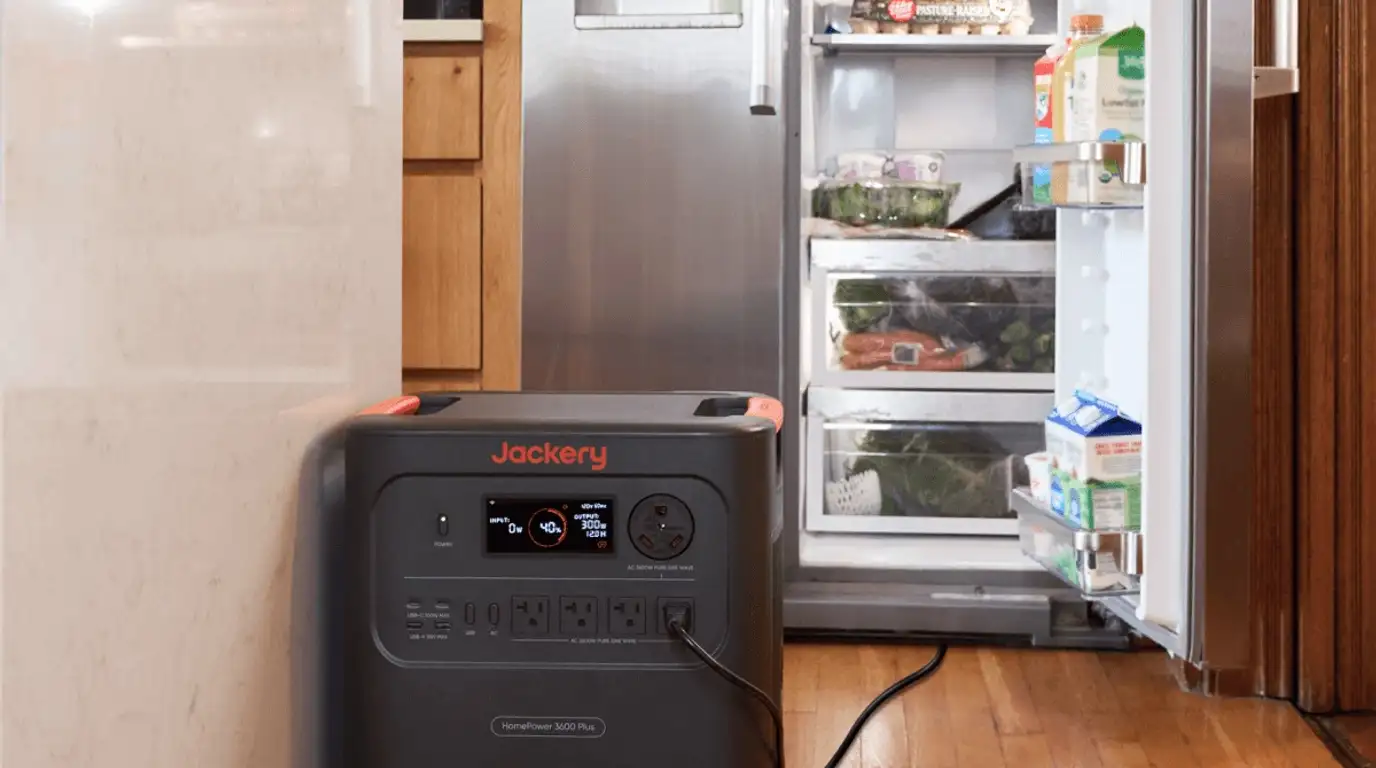
| Jackery HomePower 3600 Plus | 3,584Wh | 3,600W | 1,000W | Yes, to 21kWh | About $1,899 |
Prices are Amazon US on November 5, 2026; the DELTA 3 Max and DELTA Pro cost the same at EcoFlow. The buy boxes show the live price.
EcoFlow DELTA 3 Max: the budget week. At 2,048Wh it covers the essentials list for about 17 hours on one charge (2,048 x 0.85 is about 1,740Wh, against 2,450Wh a day), so it needs sun every day, and its 500W solar input is the bottleneck. It suits an apartment or a household that can live without the freezer.
EcoFlow DELTA 3 MaxBuy at EcoFlowCheck price on Amazon
BLUETTI Apex 300: the best recharge rate. Its 2,400W of solar input lets you add panels to make up for short winter days, and it takes extra batteries later if you want more than a day in reserve.
BLUETTI Apex 300Buy at BLUETTICheck price on Amazon
EcoFlow DELTA Pro and Jackery HomePower 3600 Plus: the most battery per dollar. At about 3.6kWh, either one carries a full day of essentials (3,600 x 0.85 = 3,060Wh) with no sun at all, which is what makes them the safer choice for a gray winter week. The DELTA Pro takes 1,600W of solar; the HomePower 3600 Plus takes 1,000W but expands to 21kWh.
EcoFlow DELTA ProBuy at EcoFlowCheck price on Amazon
Jackery HomePower 3600 PlusCheck price on Amazon
Heat during a winter outage
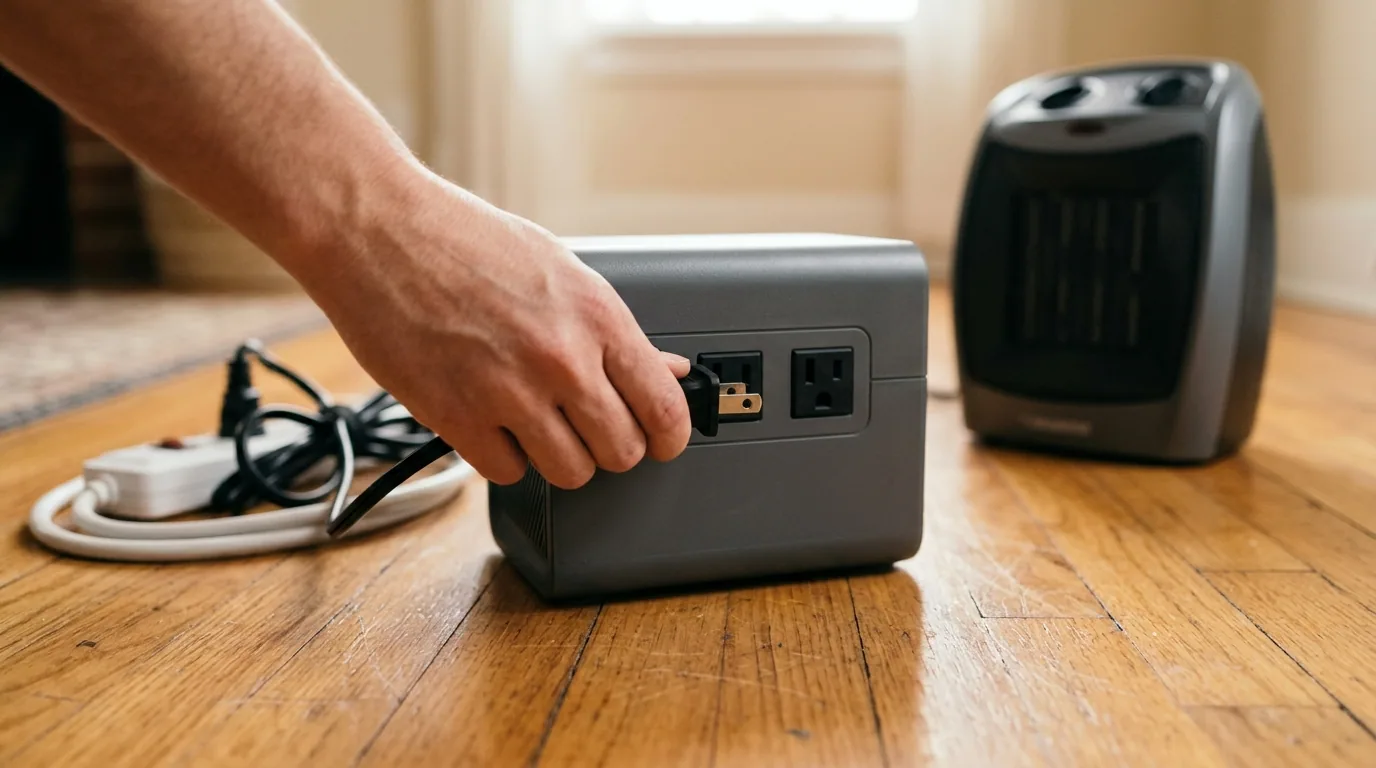
In Canada and the northern US, losing heat matters more than losing the fridge. A gas furnace still needs electricity for its blower, which draws about 875W running with a 2,350W start, and it is hardwired, so it needs a transfer switch or inlet installed by an electrician; our guide to connecting a solar generator to your house covers the options. A 1,500W space heater empties a 2kWh station in about an hour, so plan on warm clothing and one heated room rather than electric heat.
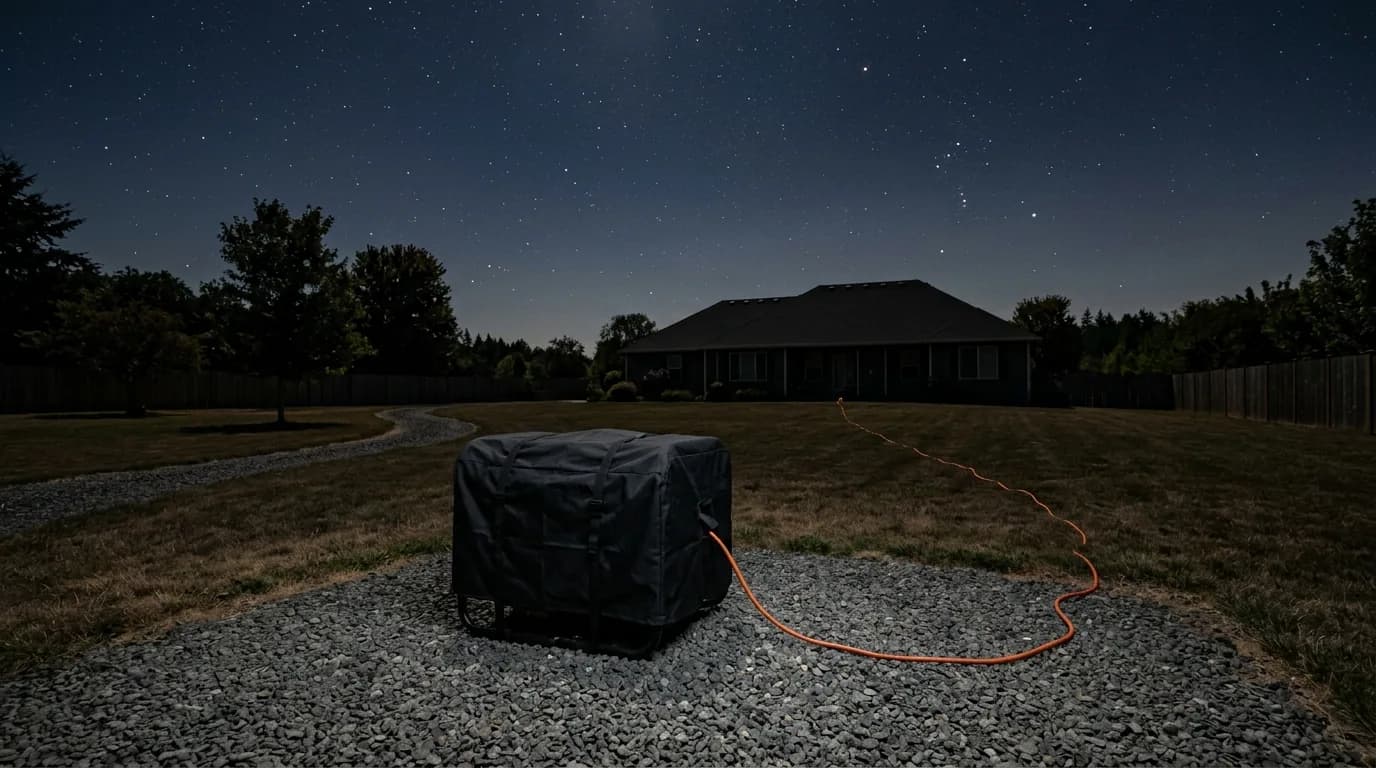
Never bring a gas generator, camp stove or barbecue indoors. The CPSC says to run portable generators "outside only, at least 20 feet away from the house," and counts nearly 100 US deaths a year from generator carbon monoxide (CPSC). The Canadian government gives the same distance, 6 metres, and notes that "battery- or solar-powered portable generators do not produce carbon monoxide and can be used anywhere" (Get Prepared).
Keep food and medicine safe
A closed refrigerator keeps food safe for about 4 hours; a full freezer holds for about 48 hours and a half-full one about 24 (CDC). Health Canada gives the same figures and adds that food left at room temperature for 2 hours or more should be thrown out (Health Canada). That is the case for powering the fridge first: past day two, everything in it is at risk.
Refrigerated medicine is the bigger concern. The CDC advises discarding refrigerated medication after a power outage of a day or more unless the label says otherwise. If someone in your home uses a CPAP, oxygen or other powered device, make a plan with the provider now. In the US, the HHS emPOWER program counts over 4.6 million people living independently who rely on electricity-dependent medical equipment or certain essential health services. In Quebec, Hydro-Québec says restoration to homes with medical devices "will not be prioritized" and recommends a backup battery (Hydro-Québec). A CPAP at 20W uses about 160Wh a night, so even a 2kWh station covers about ten nights; our CPAP power guide lists figures by machine.
Gas generator or solar generator for a week?
A gas generator runs any length of outage as long as you have fuel, and that is the catch. Generac rates its GP5500 at about 10.5 hours at half load on its 5.4-gallon tank (Generac), which works out to roughly 12 gallons a day if it runs around the clock, or more than 80 gallons in a week. Gas stations need power to pump, too. A solar generator is silent, safe indoors and refuels itself, but it is limited by battery size and weather. The two also work together: the power station runs quietly overnight and the generator tops it up on gray days. Our comparison of solar vs gas generators covers the trade-offs in detail.
Frequently Asked Questions
How do you prepare for a week without power?
Store seven days of water (one gallon or about 4 litres per person per day), food that needs no cooking or fridge, two weeks of medication, cash, flashlights and a radio. Then plan power: a 2kWh or larger power station with 400W to 800W of solar panels covers a fridge, phones, lights, a router and a CPAP for the week.
How long does the government say to prepare for a power outage?
Public Safety Canada asks for at least 72 hours of self-sufficiency, and FEMA's Ready.gov asks for several days of supplies. Some regions ask for more: PreparedBC suggests three days to a week of food, and Oregon tells residents to be two weeks ready.
How much water do you need for a week without power?
Ready.gov's figure is one gallon per person per day, so 7 gallons per person for a week. Canada's guidance is about 4 litres per person per day, or 28 litres per person. A two-person home needs about 14 gallons (56 litres), plus water for pets.
Can a solar generator power a house for a week?
Not on one charge. A typical set of essentials (fridge, router, lights, phones, laptop, CPAP) uses about 2,450Wh a day, or about 20kWh over a week. A 2kWh to 3.6kWh power station recharged by 800W of solar panels can keep up on sunny days, and a 3.6kWh unit carries a full day with no sun.
How long will food last in the fridge without power?
About 4 hours if the door stays closed, according to the CDC and Health Canada. A full freezer keeps food frozen for about 48 hours, a half-full one about 24 hours. Food that has sat at room temperature for 2 hours or more should be thrown out.
Is it safe to run a solar generator indoors?
Yes. The Canadian government notes that battery and solar generators produce no carbon monoxide and can be used anywhere. Gas generators are the opposite: run them outside only, at least 20 feet (6 metres) from the house, and never in a garage, porch or carport.
What size solar generator do I need for a week-long outage?
For a fridge, router, lights, phones and a CPAP, look for at least 2kWh of capacity and 500W or more of solar input, such as the EcoFlow DELTA 3 Max. For gray winter weeks or a freezer too, a 3.6kWh unit such as the EcoFlow DELTA Pro or Jackery HomePower 3600 Plus carries a full day without sun.