Jackery Explorer 3000 v2 vs 3000 Pro (2026): Which Jackery 3000?
Table of Contents
Affiliate disclosure: Some links on this page are affiliate links, including links to Amazon, EcoFlow and BLUETTI. If you buy through them we may earn a commission, at no extra cost to you. As an Amazon Associate we earn from qualifying purchases. This never influences our rankings or verdicts.
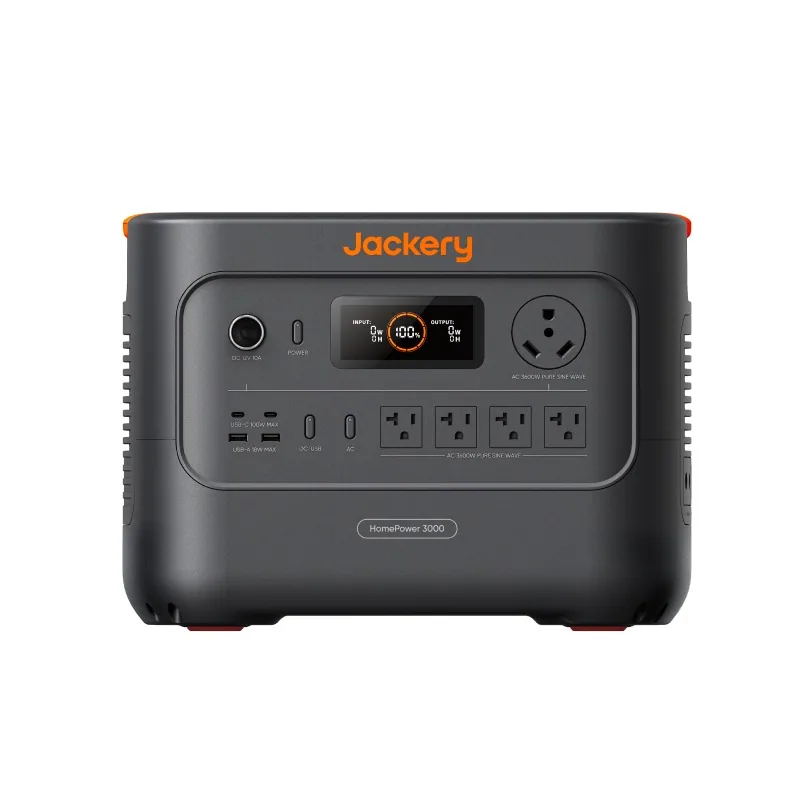
The Jackery 3000 to buy today is the Explorer 3000 v2, which Jackery sells in the US as the HomePower 3000: 3,072Wh of LiFePO4, 3,600W (7,200W surge) through four 20A outlets and a 30A TT-30 RV outlet, 59.5 lb, $1,499 on Amazon on November 14, 2026. Pick it over the older Explorer 3000 Pro unless a used Pro costs far less.
The 3000 Pro is the 2,000-cycle lithium-ion model it replaced: 3,024Wh, 3,000W, 63.9 lb, with wheels and more solar input. When we checked Jackery's US store on November 14, 2026, the only Pro it listed was a refurbished unit at $2,499, marked unavailable. The same store had the HomePower 3000 sold out at $1,499, along with its SolarSaga bundles, while Amazon had it in stock. This guide explains why the v2 and the HomePower 3000 are one product, what changed from the Pro, what a Jackery 3000 runs, and which 3kWh rivals cost less.
How we evaluated it: Our comparison is based on Jackery's US user manual for the HomePower 3000 (model JHP-3000C), its US manual for the Explorer 3000 Pro (JE-3000A), Jackery's European manual for the Explorer 3000 v2, Amazon's US listing, two hands-on reviews of the v2 (TechRadar and T3), The Solar Lab's review of the 3000 Pro, and the runtime arithmetic shown below.
Jackery HomePower 3000Check price on Amazon
Jackery 3000 models compared: Explorer 3000 v2 vs 3000 Pro
The Explorer 3000 v2 column comes from Jackery's US manual for the HomePower 3000 and its Amazon listing; the 3000 Pro column from Jackery's US manual for that model, except where another source is named.
| Spec | Explorer 3000 v2 (HomePower 3000) | Explorer 3000 Pro |
|---|---|---|
| Status, November 2026 | Sold new in the US as the HomePower 3000: in stock on Amazon, sold out at Jackery US (November 14, 2026) | Refurbished only at Jackery US, and unavailable (November 14, 2026) |
| Capacity | 3,072Wh (51.2V, 60Ah) | 3,024Wh (43.2V, 70Ah) |
| Cells | LiFePO4 | Lithium-ion (NMC) |
| Cycle life | 4,000 cycles to 70% | 2,000 cycles to 70% |
| AC output | 3,600W, 7,200W surge, 120V | 3,000W, 6,000W surge, 120V |
| AC outlets | Four 120V 20A, plus a 30A TT-30 RV outlet | Four 120V 20A, plus a TT-30 RV outlet limited to 25A |
| USB and 12V | Two USB-C (100W), two USB-A (18W), 12V car port (10A) | Two USB-C (100W), two USB-A (18W Quick Charge 3.0), 12V car port (10A) |
| Switch to battery in an outage | 20 ms or less | Within 20 ms |
| Load allowed while plugged in | 1,440W (12A bypass) | 1,440W (12A bypass) |
| Wall charging | 2.2 hours; 1.7 hours with AC and solar together | About 2.4 hours (Jackery's figure, as retailers list it) |
| Solar input | 1,000W max, two 8mm inputs, 16-60V, 12A each | 1,400W max, two 8mm inputs, 17.5-60V, 12A each |
| Weight | 59.5 lb | 63.9 lb |
| Size | 16.4 x 12.8 x 12 in | 18.6 x 14.1 x 14.7 in |
| Moving it | Two molded handles, no wheels | Wheels and a telescoping handle (The Solar Lab) |
| Operating temperature | Charge 32 to 113°F; discharge 5 to 113°F (2,000W max from 5 to 14°F) | Charge 32 to 104°F; discharge -4 to 104°F |
| Warranty | 3 years, plus 2 more when you register | 3 years, plus 2 more when you register |
| Price | $1,499 on Amazon, sold by Amazon (November 14, 2026); $1,499 at Jackery US, sold out | No new listing at Jackery US; its refurbished unit showed $2,499 (November 14, 2026) |
Jackery HomePower 3000Check price on Amazon
Is the Explorer 3000 v2 the same as the HomePower 3000?
Yes, for anything a buyer can see or measure, although Jackery has not published a statement saying so. The evidence:
- Identical spec sheets. Jackery's European manual for the Explorer 3000 v2 and its US manual for the HomePower 3000 list the same 3,072Wh (51.2V, 60Ah) LiFePO4 pack, 59.5 lb, 16.4 x 12.8 x 12 in, 4,000 cycles to 70%, and the same pair of 8mm solar inputs capped at 1,000W.
- Jackery pairs the names itself. Its US store, including its Explorer 3000 v2 FAQ page, offers a large carrying case listed as "Compatible with HomePower 3000/Explorer 3000 v2".
- Launch coverage. 9to5Toys reported Jackery's May 15, 2025 US launch of the "HomePower 3000 (aka the Explorer 3000 v2)", with a 20 ms switchover, a TT-30R port and 1,000W of solar input.
- The same front panel. T3, reviewing the UK Explorer 3000 v2, notes that US buyers get four 120V outlets plus a TT-30 socket, which is the HomePower 3000's layout.
The model numbers differ: Best Buy lists its Explorer 3000 v2 as JE-3000B, and Amazon's HomePower 3000 is JHP-3000C. We found no spec difference behind that, so treat the two names as one product. In the US the Explorer 3000 v2 name lives on mainly at retailers: Jackery's own US store listed no product under that name on November 14, 2026, Best Buy's listing showed it sold out the same day, and Lowe's lists it in bundles with a manual transfer switch or a trolley. Buy whichever is cheaper from Jackery, Jackery's Amazon listing or an authorized dealer, the sellers Jackery's warranty covers, and check that the photo shows the five-outlet front with the TT-30.
Our Jackery HomePower 3000 review covers the same unit under its US name, and our Jackery lineup guide shows where it sits in the range.
What changed from the Explorer 3000 Pro
LiFePO4 cells double the cycle rating
The 3000 Pro uses lithium-ion (NMC) cells rated for 2,000 cycles to 70% capacity; the v2 switched to LiFePO4 rated for 4,000, and gained 48Wh along the way. At one full cycle a day that is about 5.5 years against 11. For a unit that only comes out a few dozen times a year in outages, both ratings outlast the warranty, but the v2 is the one to buy if it will cycle daily on solar or time-of-use rates. Our LiFePO4 vs NMC guide explains the trade-offs.
More output and a full 30A RV outlet
The v2's inverter is rated 3,600W continuous and 7,200W surge, against 3,000W and 6,000W for the Pro. The difference shows up when big loads overlap: a 1,500W space heater, a 1,500W microwave and a running refrigerator (up to 192W) add up to about 3,200W, over the Pro's limit and inside the v2's. The RV outlet changed too. The Pro's TT-30 is limited to 25A, about 3,000W; the v2's is rated for the full 30A, 3,600W.
Smaller and lighter, but no wheels
Jackery says the v2 builds its cells into the case structure (cell-to-body, in its Amazon listing), which cut it to 59.5 lb and 16.4 x 12.8 x 12 in, against 63.9 lb and 18.6 x 14.1 x 14.7 in for the Pro. The catch is how you move it. The Pro has wheels and a telescoping handle; the v2 has two molded handles and nothing to roll on. One Best Buy owner answered that they move theirs on a furniture dolly, and Jackery sells a separate trolley, which Lowe's bundles with the v2. Among the 3kWh stations with a 3,600W inverter we cover, it is still the lightest: the PECRON F3000LFP weighs 63.3 lb, the EcoFlow DELTA 3 Ultra 72.1 lb and the Anker SOLIX F3000 91.5 lb.
Solar input is where the Pro wins
The Pro accepts up to 1,400W of solar across its two 8mm inputs; the v2 stops at 1,000W. Both use Jackery's 8mm (DC8020) connectors rather than MC4 or XT60, so panels from other brands need an adapter, a point TechRadar and T3 both raised. Jackery's manual says each v2 input takes one SolarSaga 500X or two SolarSaga 200 panels, and that both inputs must carry the same panel model and the same number of panels.
What the Jackery Explorer 3000 v2 runs, and for how long
Usable energy after inverter losses: 3,072 x 0.85 = about 2,611Wh. Runtime in hours = 2,611 / the load in watts. The refrigerator and freezer rows use ENERGY STAR's certified daily energy because their compressors cycle; the other draws come from our appliance power guide.
| Load | Draw | Runtime on the 3000 v2 |
|---|---|---|
| Full-size refrigerator (ENERGY STAR median, 1,500Wh a day) | About 63W average | About 42 hours |
| Chest freezer, 7 cu ft (620Wh a day) | About 26W average | About 4 days |
| CPAP, no heated humidifier | 20W | About 130 hours (16 nights of 8 hours) |
| CPAP with heated humidifier | 55W | About 47 hours (almost 6 nights) |
| Wi-Fi router and modem | 20W | About 5 days |
| 55-inch TV | 97W | About 27 hours |
| 5,000 BTU window AC | 347W | About 7.5 hours |
| Gas furnace blower, 1/2 HP | 875W (2,350W to start) | About 3 hours of blower run time |
| Sump pump, 1/2 HP | 1,050W (2,150W to start) | About 2.5 hours of pump run time |
| RV roof AC, 13,500 BTU | 1,800W (2,800W to start) | About 1.5 hours |
| Space heater, high | 1,500W | About 1.7 hours |
A realistic outage day: a refrigerator (1,500Wh), a router and modem around the clock (480Wh), a 55-inch TV for four hours (388Wh), five LED bulbs for five hours (250Wh) and two phone charges (40Wh) total about 2,660Wh. That is almost exactly one day per full charge, so plan on solar or a generator for anything longer. The 3000 Pro's 3,024Wh gives nearly the same results. Jackery's own claim of 1 to 2 days for a refrigerator fits the arithmetic for an efficient fridge.
What it cannot run: anything on 240V, such as most deep-well pumps, central air, an electric dryer or a Level 2 EV charger. The v2 outputs 120V only, and Jackery answered on Best Buy that the Explorer 3000 v2 "does not have compatible expansion batteries", so 3,072Wh is all you get. For CPAP users, our CPAP power station guide covers running a machine from the 12V port, which skips the inverter loss.
Charging the Explorer 3000 v2
- Wall: 2.2 hours from a standard outlet, or 1.7 hours with wall and solar charging together (Jackery's Amazon listing). The AC input takes 100 to 120V at up to 15A.
- Solar: 1,000W maximum across the two 8mm inputs (16 to 60V, 12A each). Jackery rates 80% in about 9 hours on two SolarSaga 200W panels, and T3 put a full charge at about 22 hours on one. With 1,000W of panels, a planning figure is 1,000W x 5 peak sun hours x 0.75 = about 3,750Wh a day, more than a full charge.
- Car: a 12V car charger works, but the cable is sold separately, and T3 lists about 36 hours for a full charge that way.
- Gas generator: Jackery's answer on Best Buy says any generator supplying 100 to 120V at 60Hz will charge it.
- App: Wi-Fi (2.4GHz only) and Bluetooth. The app sets a charging schedule for time-of-use rates, a quiet charging mode, a battery-saving mode that limits usable capacity to extend cell life, and a self-powered mode that uses stored solar before grid power.
Our guide to how many solar panels a power station needs works through panel counts for a 3kWh battery.
Using the 3000 v2 as a UPS: two limits to know
Jackery rates the switchover at 20 ms or less and lists the UPS as UL-certified on Amazon. That keeps a router, a modem, security cameras and most desktop PCs running through a cut. Two details in the manual matter more than the switch time:
- 1,440W while plugged in. In UPS (bypass) mode the wall feeds your devices through the unit, capped at 12A, or 1,440W. A refrigerator and a microwave together can exceed that while the grid is up, even though the battery carries them after the cut. Jackery recommends one device at a time in UPS mode and says it does not switch in 0 ms, so it is not for servers or workstations.
- The 12-hour auto-off. Energy Saving Mode is on by default: if nothing is connected, or the AC load stays at 25W or less (2W on USB or the 12V port), the unit turns every output off after 12 hours. A router and modem drawing 20W fall under that line. Turn Energy Saving Mode off (hold the AC and main power buttons together for 3 seconds) or change the shutdown time in the app before you rely on it through a long outage.
Our explainer on pass-through charging and UPS mode covers how this works across brands, and connecting a power station to your house covers the transfer switch that Lowe's bundles with the v2.
What reviewers found with the Explorer 3000 v2
Both hands-on reviews we found used UK units (230V, three outlets), so the outlets differ from the US model, but the battery, inverter rating and body are the same.
- TechRadar ran a 3 HP air compressor that peaked around 2,250W and spray-painted a shed for a day on 30% of the battery (100% down to 70%). Its complaints: no IP rating or outlet covers, the 8mm solar sockets, and an app that took about 5 seconds to respond to a tap.
- T3 ran a kettle, an induction hob and a heater on high at once. The screen showed 5,039W, the fan ran flat out, and the unit held for about 25 seconds before the inverter cut out. With the heater on low the load settled at 3,022W, which T3 put at about 0.8 hours of use. Its reviewer could carry the unit about 15 meters before resting.
What we like
- 3,600W and 7,200W surge in 59.5 lb, the lightest 3kWh unit with a 3,600W inverter in our coverage
- LiFePO4 cells rated for 4,000 cycles, double the 3000 Pro's rating
- A full 30A TT-30 outlet for an RV
- A 2.2-hour wall charge and time-of-use scheduling in the app
- Up to five years of warranty when you register
What we don't like
- No extra battery and no 240V output
- Solar input stops at 1,000W, through Jackery's own 8mm connectors
- No wheels on a 59.5 lb box
- A 1,440W limit while plugged in, and a 12-hour auto-off you have to switch off for small loads
- Indoor use only, per Jackery's manual: no weather sealing for a campsite in the rain
Should you buy a used or refurbished Explorer 3000 Pro?
Only at a steep discount. The Solar Lab's review measured a 7W idle draw and about 80% inverter efficiency, ran the Pro at its rated 3,000W for long stretches, and got about 4,500W of surge reliably against Jackery's 6,000W rating. It is a capable box, and its wheels and 1,400W of solar input beat the v2.
Against that, its NMC cells are rated for half the v2's cycles, it is bigger and heavier, and Jackery's warranty covers only the original buyer and does not transfer, so a Pro bought secondhand from its owner has none. With the v2 at $1,499 new, we would want a used Pro under about $1,000 before choosing it. Jackery's own refurbished Pro was listed at $2,499 (unavailable) on November 14, 2026, $1,000 more than a new v2 on Amazon that day. Our used power station checklist covers what to check before you pay.
Other 3kWh power stations to compare with the Jackery 3000
Prices are Amazon US on November 14, 2026; specs come from our reviews of each model.
| Model | Capacity | Output (surge) | Solar input | Expandable | Weight | Price |
|---|---|---|---|---|---|---|
| Jackery Explorer 3000 v2 / HomePower 3000 | 3,072Wh | 3,600W (7,200W) | 1,000W | No | 59.5 lb | $1,499 |
| EcoFlow DELTA 3 Ultra | 3,072Wh | 3,600W (7,200W) | 800W | No | 72.1 lb | $1,299 |
| BLUETTI Elite 300 | 3,014Wh | 2,400W (4,800W) | 1,200W | No | 58 lb | $1,198.99 |
| PECRON F3000LFP | 3,072Wh | 3,600W (4,500W for 5 s) | 1,600W | To 10,752Wh | 63.3 lb | $899 |
| Jackery HomePower 3600 Plus | 3,584Wh | 3,600W (7,200W) | 1,000W | To 21kWh | 77.2 lb | $1,899 |
The EcoFlow DELTA 3 Ultra is the closest match: the same capacity, the same 3,600W and 7,200W ratings and the same four 20A outlets plus a TT-30, for $200 less on Amazon that day, with a switchover EcoFlow rates under 10 ms. It weighs 12.6 lb more and takes only 800W of solar. The PECRON costs $600 less and adds expansion and 1,600W of solar, with a weaker surge rating. The HomePower 3600 Plus is the Jackery to buy if you might add batteries or pair two units for 240V later.
EcoFlow DELTA 3 UltraBuy at EcoFlowCheck price on Amazon
Which Jackery 3000 should you buy?
- Buy the Explorer 3000 v2, sold as the HomePower 3000, if you want Jackery's 3kWh station: LiFePO4 cells, 3,600W, a full 30A RV outlet and the lightest body in its class, at $1,499 on Amazon (Jackery's own store had it sold out on November 14, 2026).
- Buy a used 3000 Pro only well under $1,000, or if wheels and 1,400W of solar matter more to you than cycle life and warranty.
- Buy the EcoFlow DELTA 3 Ultra instead if you are not set on Jackery and can carry 72 lb: the same core specs for $200 less.
- Buy the HomePower 3600 Plus instead if 3kWh might not be enough later, since the 3000 v2 cannot grow.
For a single 3kWh box that one person can lift into a car, the Explorer 3000 v2 is the best Jackery 3000 and the one we would buy. Just switch off Energy Saving Mode before you trust it with a router overnight, and keep big loads under 1,440W while it is plugged in.
Jackery HomePower 3000Check price on Amazon
Frequently Asked Questions
Is the Jackery Explorer 3000 v2 the same as the HomePower 3000?
Yes, as far as any buyer can tell. Jackery's manuals give both the same 3,072Wh LiFePO4 pack, 3,600W inverter, 59.5 lb weight and 1,000W solar input, Jackery sells one carrying case for both names, and 9to5Toys covered the 2025 US launch as the HomePower 3000, aka the Explorer 3000 v2. Only the model numbers differ (JE-3000B at Best Buy, JHP-3000C on Amazon).
Is the Jackery Explorer 3000 Pro discontinued?
Jackery's US store no longer lists the Explorer 3000 Pro new: when we checked on November 14, 2026, it appeared only as a refurbished unit at $2,499, marked unavailable. Its replacement is the Explorer 3000 v2, sold in the US as the HomePower 3000, which Amazon had in stock at $1,499 that night while Jackery's own store had it sold out. Some retailers may still have new Pro stock.
How long will a Jackery 3000 run a refrigerator?
About 42 hours for a full-size ENERGY STAR refrigerator using 1,500Wh a day, from the Explorer 3000 v2's roughly 2,611Wh of usable energy (3,072Wh x 0.85). An older fridge that averages 150W gets about 17 hours. The 3000 Pro's 3,024Wh gives nearly the same result.
Can you add an extra battery to the Jackery Explorer 3000 v2?
No. Jackery has said the Explorer 3000 v2 has no compatible expansion batteries, so capacity stays at 3,072Wh. If you want to add batteries later, the Jackery HomePower 3600 Plus expands to 21kWh, and the PECRON F3000LFP takes a 3,840Wh pack.
How long does the Jackery 3000 v2 take to charge?
About 2.2 hours from a wall outlet, or 1.7 hours with wall and solar charging together, according to Jackery. On solar, two SolarSaga 200W panels reach 80% in about 9 hours, and the full 1,000W input refills it in roughly 4 hours of strong sun. A 12V car socket takes about 36 hours, per T3.
Can a Jackery 3000 run an RV air conditioner?
Yes. A 13,500 BTU RV roof AC draws about 1,800W running and 2,800W to start, inside the Explorer 3000 v2's 3,600W and 7,200W surge, and its 30A TT-30 outlet takes an RV's 30A cord directly. Expect about 1.5 hours of compressor time per charge, so pair it with solar or a generator for a full night.
Does the Jackery Explorer 3000 v2 work as a UPS?
Yes. Jackery rates the switchover at 20 ms or less, enough for routers, cameras and most desktop PCs. While plugged into the wall the unit passes through only 1,440W, and its default Energy Saving Mode turns outputs off after 12 hours if the AC load stays at 25W or less, so switch that mode off for a router.
What is the difference between the Jackery 3000 Pro and 3000 v2?
The 3000 v2 has LiFePO4 cells rated for 4,000 cycles instead of 2,000, a 3,600W inverter instead of 3,000W, a full 30A TT-30 outlet, and weighs 59.5 lb instead of 63.9 lb. The 3000 Pro keeps two advantages: wheels with a telescoping handle, and 1,400W of solar input against the v2's 1,000W.