Jackery Lineup Explained (2026): v2 vs Plus vs HomePower
Table of Contents
Affiliate disclosure: Some links on this page are affiliate links, including links to Amazon, EcoFlow and BLUETTI. If you buy through them we may earn a commission, at no extra cost to you. As an Amazon Associate we earn from qualifying purchases. This never influences our rankings or verdicts.
Jackery's US store sold 15 portable power stations new on October 11, 2026 (one of them, the Explorer 2000 Plus, only in kits), split into two families: Explorer (portable boxes from the 288Wh Explorer 300D at $209 to the 5,040Wh Explorer 5000 Plus at $3,149, then on sale; $3,499 by November 4) and HomePower (home backup units from the 1,024Wh HomePower 1000 v2 at $549 to the 3,584Wh HomePower 3600 Pro Max at $1,799). In Jackery's naming, "Plus" means the station takes extra battery packs, "v2" means the current second generation, and "HomePower" adds home-backup features such as priority circuits and fast UPS switchover.
This guide lists every current US model in one table, explains what each line is for, picks one model per use and names the older models Jackery has stopped selling new. It is built from Jackery's US store and product pages and Jackery's Amazon US listings, checked September 30, 2026, with every price re-checked on October 11, 2026. Both stores were running sale prices that day; Jackery's list prices were up to $350 higher (the Explorer 1000 v2 lists at $559 and the Explorer 2000 v2 at $999, for example). Prices move often, so treat ours as approximate.
Every current Jackery power station, in one table
The last column is a quick sizing check: how long each station runs a full-size refrigerator averaging 150W. It uses usable Wh = rated Wh x 0.85 (inverter and conversion losses) and runtime in hours = usable Wh / average load in watts, so the Explorer 1000 v2's 1,070Wh gives 1,070 x 0.85 / 150 = about 6.1 hours.
The figures here use planning draws: a conservative 150W average for a full-size fridge (a new ENERGY STAR model averages closer to 63W, so expect longer runtimes) and a conservative 40W for a CPAP (ResMed's battery guide lists about 8 to 20W for an AirSense 10 with its humidifier off, measured through ResMed's 12V DC converter, so expect longer CPAP runtimes than shown, especially from a 12V outlet, and up to about 55W with the humidifier at its highest setting, or about 67W with a heated tube as well).
| Model | Line | Capacity | AC output | Expandable | Weight | Price (Oct 11, 2026) | 150W fridge |
|---|---|---|---|---|---|---|---|
| Explorer 300D | Explorer (DC only) | 288Wh LiFePO4 | None (USB and DC ports, 140W) | No | 5.5 lb | About $209 (jackery.com) | No AC outlet |
| Explorer 300 | Explorer | 292Wh LiFePO4 (Amazon) or 293Wh lithium-ion (Jackery) | 300W | No | 7.1 to 7.5 lb | About $259 | About 1.7 hours |
| Explorer 1000 v2 | Explorer | 1,070Wh LiFePO4 | 1,500W (3,000W surge) | No | 23.8 lb | About $559 | About 6.1 hours |
| Explorer 1000 Plus | Explorer Plus | 1,264Wh LiFePO4 | 2,000W | Was, to about 5kWh (pack discontinued) | Not listed | About $619 (jackery.com) | About 7.2 hours |
| Explorer 1500 v2 | Explorer | 1,536Wh LiFePO4 | 2,000W (4,000W surge) | No | 32.0 lb | About $849 (jackery.com) | About 8.7 hours |
| Explorer 1500 Ultra | Explorer Ultra | 1,536Wh LiFePO4 | 1,800W (3,600W peak) | No | 38.6 lb | About $1,079 | About 8.7 hours |
| Explorer 2000 v2 | Explorer | 2,042Wh LiFePO4 | 2,200W (4,400W surge) | No | 39.5 lb | About $999 | About 11.6 hours |
| Explorer 2000 Plus | Explorer Plus | 2,042Wh LiFePO4 | 3,000W | Yes, to 12kWh (24kWh with two units) | 62 lb | New only in kits at Jackery (from $1,429 with a solar panel); unavailable on Amazon US | About 11.6 hours |
| Explorer 5000 Plus | Explorer Plus | 5,040Wh LiFePO4 | 7,200W, 120V and 240V | Yes, to 60kWh | About 134.5 lb | About $3,499 | About 28.6 hours |
| HomePower 1000 v2 | HomePower | 1,024Wh LiFePO4 | 1,500W (3,000W surge) | No | 23.4 lb | About $549 | About 5.8 hours |
| HomePower 1000 Plus v2 | HomePower Plus | 1,024Wh LiFePO4 | 1,800W (3,600W surge) | Yes, to about 11kWh | 23.8 lb | About $699 | About 5.8 hours |
| HomePower 2000 Plus v2 | HomePower Plus | 2,048Wh LiFePO4 | 2,400W (4,800W surge) | Yes, to about 12kWh | 41.5 lb | About $1,069 | About 11.6 hours |
| HomePower 3000 | HomePower | 3,072Wh LiFePO4 | 3,600W (7,200W surge), TT-30 outlet | No | 59.5 lb | About $1,499 | About 17.4 hours |
| HomePower 3600 Plus | HomePower Plus | 3,584Wh LiFePO4 | 3,600W; 7,200W and 240V with two units | Yes, to 21kWh | 77.2 lb, wheels | About $1,899 | About 20.3 hours |
| HomePower 3600 Pro Max | HomePower | 3,584Wh LiFePO4 | 2,000W at 120V, 4,000W at 240V | Yes, to 21.5kWh | 73.9 lb | About $1,799 | About 20.3 hours |
Sources: Jackery's US power station collection and each model's jackery.com product page, plus Jackery's Amazon US listings, checked September 30, 2026; prices re-checked October 11, 2026. Prices marked (jackery.com) come from Jackery's own store; the rest were the same on jackery.com and Amazon US (checked with a US delivery address) unless both are shown. The Explorer 1000 Plus weight is missing because its current jackery.com listing does not state one. Jackery's collection page also carries a few errors (it shows the HomePower 1000 Plus v2 as both 1,024Wh and 1,280Wh, for example); the figures above come from each product's own spec table.
What do "Explorer", "Plus", "v2", "Ultra" and "HomePower" mean?
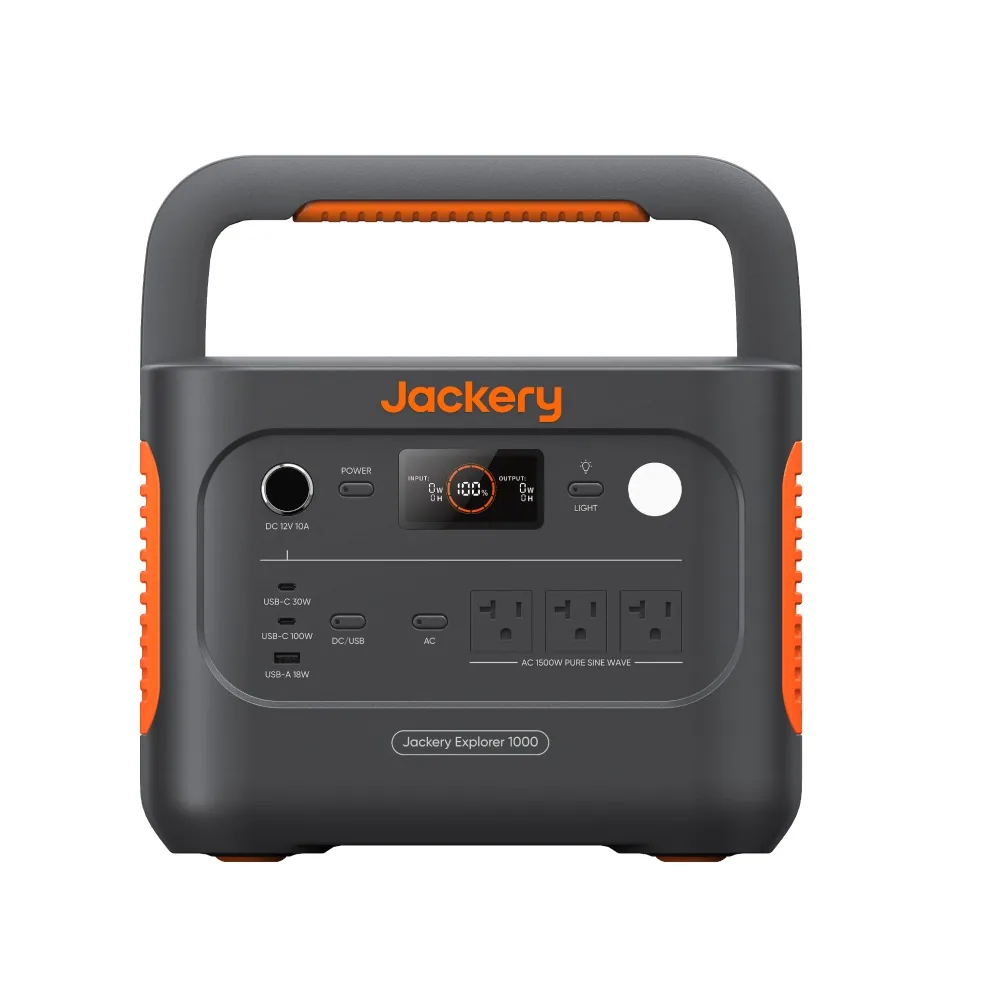
- Explorer is Jackery's portable line: one sealed box with a handle, sized from a camping battery to a whole-home unit. Most Explorers have a 12V car port and charge from Jackery's SolarSaga panels.
- v2 marks the second generation. The v2 Explorers (1000 v2, 1500 v2, 2000 v2) use LiFePO4 cells, fast wall charging and an app, and Jackery sells none of them with an expansion battery.
- Plus means expandable. The Explorer 2000 Plus and 5000 Plus and the HomePower 1000 Plus v2, 2000 Plus v2 and 3600 Plus all accept add-on battery packs. The packs are not interchangeable across generations: Jackery says the HomePower 1000 Plus v2 and 2000 Plus v2 take only the Battery Pack 2000 Plus v2, not the older Battery Pack 2000 Plus or 1000 Plus.
- Ultra is the rugged option. The Explorer 1500 Ultra has an IP65 dust- and water-resistant case, 800W of solar input and a 3,600W peak that Jackery says holds for 5 seconds.
- D models (the Explorer 300D here) have no AC inverter at all: they are large USB-C and DC batteries for phones, laptops and a Starlink Mini.
- HomePower is the home backup line. The newer HomePower units list 6,000-cycle LiFePO4 cells, sub-10ms UPS switchover (HomePower 1000 v2, 1000 Plus v2 and 3600 Pro Max) and Jackery Priority Routing, which cuts power to non-essential outlets at a battery level you set so the fridge keeps running. The HomePower 3000 is the older design: 4,000 cycles, a 20ms-or-less UPS and a TT-30 RV outlet.
- Pro Max (HomePower 3600 Pro Max) is the HomePower built around 240V: one unit gives 4,000W from a NEMA 14-50 outlet, while its two NEMA 5-20 outlets share 2,000W at 120V, and Jackery positions it for a manual transfer switch. The Explorer 5000 Plus is the only other Jackery that makes 240V without a second unit.
Explorer or HomePower: which line should you buy?
Buy an Explorer if the station leaves the house: camping, tailgates, a van, a job site. The sealed Explorer v2 boxes are a little lighter than their HomePower counterparts (the Explorer 2000 v2 weighs 39.5 lb against 41.5 lb for the HomePower 2000 Plus v2), the Explorer 1000 v2 packs 46Wh more than the HomePower 1000 v2, though it now costs more ($559 against $499 for the black HomePower 1000 v2, October 30, 2026), and the Explorer 1500 Ultra is the model Jackery builds for weather, with an IP65 rating.
Buy a HomePower unit if its main job is riding out outages at home. The practical differences are the ones you use during a blackout: a faster switchover for a desktop PC or router, circuits you can prioritize so a coffee maker cannot drain the battery the fridge needs, time-of-use scheduling in the app, and on the Plus models an expansion path measured in 2kWh or 3.6kWh steps. At 1kWh the HomePower 1000 Plus v2 costs about $190 more than the Explorer 1000 v2 on Amazon ($749 against $559 at the end of October 2026); the HomePower 1000 Plus v2 review walks through whether that premium is worth it.
Which Jackery should you buy for your use?
Phones, laptops and a weekend of camping: Explorer 300
The Explorer 300 on Amazon is a 292Wh LiFePO4 unit with two AC outlets and a 100W USB-C port for about $259. It runs a 40W CPAP for about 6.2 hours (292 x 0.85 / 40) and a 60W laptop for about 4.1 hours. Check which version you are getting before you order: Jackery's own store still sells an older 293Wh lithium-ion Explorer 300, also at $259, and our Jackery Explorer 300 review explains how to tell them apart. If you need no AC outlet at all, Jackery's 5.5 lb Explorer 300D is cheaper at about $209.
Jackery Explorer 300 (LiFePO4)Check price on Amazon
CPAP, camping trips and short outages: Explorer 1000 v2
At about $559 on Amazon (October 30, 2026), the Explorer 1000 v2 is Jackery's simplest 1kWh station: 1,070Wh, 1,500W (3,000W surge), three AC outlets and a one-hour wall charge in Emergency mode (1.7 hours by default). That is about 22.7 hours of a 40W CPAP, or about 6.1 hours of a full-size fridge. It cannot take an extra battery. Full details are in our Explorer 1000 v2 review.
Jackery Explorer 1000 v2Check price on Amazon
An apartment or fridge backup you can grow: HomePower 1000 Plus v2
The HomePower 1000 Plus v2 starts at 1,024Wh with 1,800W across four AC outlets on two independently controlled circuits, switches to battery in under 10ms and adds up to five 2,048Wh Battery Pack 2000 Plus v2 packs for about 11kWh. Each pack listed at $999 on jackery.com on October 31, 2026, or about $650 more in the $1,399 station-plus-pack bundle. With one pack it runs a 150W fridge for about 17.4 hours (3,072 x 0.85 / 150).
Jackery HomePower 1000 Plus v2Check price on Amazon
A 2kWh box that stays sealed: Explorer 2000 v2
The Explorer 2000 v2 is the lightest 2kWh Jackery at 39.5 lb, with 2,200W from three AC outlets for about $999. It runs a 5,000 BTU window AC averaging 450W for about 3.9 hours and charges from the wall in about 1.7 hours in Emergency mode. It is not expandable, and its 400W solar ceiling is low for its size; our Explorer 2000 v2 review compares it with the HomePower 2000 Plus v2, which fixes both for about $170 more.
Jackery Explorer 2000 v2Check price on Amazon
Job sites and bad weather: Explorer 1500 Ultra
The Explorer 1500 Ultra is the one to take somewhere wet or dusty: an IP65 case, a one-meter drop rating per Jackery, 1,536Wh, 1,800W continuous with 2,000W for up to 15 minutes, a 1.5-hour wall charge and 800W of solar input, for about $1,079. It runs a 1/3 HP sump pump drawing about 800W for about 1.6 hours (1,536 x 0.85 / 800), and Jackery rates it to operate from 5°F to 113°F.
Jackery Explorer 1500 UltraCheck price on Amazon
RVs with a TT-30 inlet: HomePower 3000
The HomePower 3000 has a built-in TT-30 RV outlet, so an RV's 30A cord plugs straight in, and at about $1,499 for 3,072Wh and 3,600W it is the cheapest Jackery above 3kWh. It is not expandable and is 120V only. Our HomePower 3000 review has the charging and transfer-switch details.
Jackery HomePower 3000Check price on Amazon
Whole-home essentials and 240V: HomePower 3600 Plus, 3600 Pro Max or Explorer 5000 Plus
Three routes, depending on your panel and budget. The HomePower 3600 Plus (about $1,899) gives 3,584Wh and 3,600W at 120V on wheels, grows to 21kWh, and reaches 240V only with a second unit in parallel; see our HomePower 3600 Plus review. The HomePower 3600 Pro Max (about $1,799) has the same capacity but trades 120V muscle (2,000W in total at 120V) for 4,000W of 240V from one unit, which suits a well pump or a 240V circuit on a manual transfer switch. The Explorer 5000 Plus (about $3,499) does both at once: 7,200W at 120V and 240V, up to 4,000W of solar input and expansion to 60kWh, covered in our Explorer 5000 Plus review. For a Gulf Coast hurricane or a California PSPS shutoff lasting days, pair any of them with solar.
Jackery HomePower 3600 PlusCheck price on Amazon
Which Jackery models are discontinued or on their way out?
| Model | Status on October 11, 2026 | What to look at instead |
|---|---|---|
| Explorer 300 Plus | No longer sold new by Jackery US | Explorer 300 (LiFePO4, Amazon); see our Explorer 300 Plus review |
| Explorer 300 v2 | Sold out on jackery.com ($279) | Explorer 300 (LiFePO4, Amazon) |
| Explorer 100 Plus, Explorer 240 v2 | Sold out on jackery.com | Explorer 300D or Explorer 300 |
| Explorer 600 v2 | Sold out on jackery.com ($499); on Amazon only through third-party sellers, with no buy box | Explorer 1000 v2, about $559; see our Explorer 600 v2 review |
| Explorer 1000 Plus | Still on jackery.com at $619, but Jackery says its Battery Pack 1000 Plus is discontinued, so it can no longer be expanded new | HomePower 1000 Plus v2; see our Explorer 1000 Plus review |
| Explorer 1500 v2 | In stock on jackery.com at $849 on October 11, 2026; Jackery's Amazon US store did not list it on September 30 | Explorer 1500 Ultra; see our Explorer 1500 v2 review |
| Explorer 2000 Plus | Sold new only in kits on jackery.com (from $1,429 with a solar panel); unavailable on Amazon US | HomePower 2000 Plus v2; see our Explorer 2000 Plus review |
| Explorer 1000 (original), 1000 Pro, 2000 Pro, 3000 Pro, Explorer 240, 290 Plus | Sold out or refurbished only on jackery.com | The current model at the same capacity in the table above |
Two of these are our reading of the evidence rather than Jackery statements. Jackery has not said the Explorer 2000 Plus is ending; we infer it from Jackery selling it new only in kits while Amazon US lists it as unavailable. And the Explorer 1500 v2 is harder to call: Jackery's store showed it sold out earlier in September, on September 30 the same listing was taking orders again while Amazon US no longer carried it, and on October 11 it was in stock at $849. If you want a new Jackery with a long parts and warranty runway, the v2, Ultra and HomePower models in the main table are the safer buys.
How does Jackery's warranty work?
Most current Jackery stations carry 5 years in total: 3 years standard plus a 2-year extension. Jackery's product pages say the extension is activated automatically on jackery.com purchases, and its FAQ says the warranty applies to buyers from the official website, Jackery-branded stores on other platforms and authorized dealers. Jackery's Amazon listings for the 2000 v2, 1500 Ultra, HomePower 1000 Plus v2 and HomePower 3000 all state 5 years. The Amazon listing for the Explorer 300 states 2 years, and the older lithium-ion Explorer 300 on jackery.com lists 2 years plus a 1-year extension. Keep your order confirmation either way. Our solar generator warranty guide compares Jackery's terms with other brands'.
Jackery lineup explained: the short version
For most people the Jackery lineup comes down to four stations. The Explorer 300 (about $259) for devices and camping, the Explorer 1000 v2 (about $559) as the sealed 1kWh unit, the HomePower 1000 Plus v2 (about $699) if you want to start small and add batteries, and the Explorer 2000 v2 (about $999) for 2kWh in one box. Go to the HomePower 3000, 3600 Plus or Explorer 5000 Plus only when you are backing up a house rather than a room. For how Jackery stacks up against other brands, see our EcoFlow vs Jackery and Anker SOLIX vs Jackery comparisons.
Frequently Asked Questions
What is the difference between Jackery Explorer and HomePower?
Explorer is Jackery's portable line, from the 288Wh Explorer 300D to the 5,040Wh Explorer 5000 Plus. HomePower is its home backup line (1,024Wh to 3,584Wh), with features aimed at outages: priority circuits that shut off non-essential outlets at a battery level you set, time-of-use scheduling and, on the newer models, 6,000-cycle cells and sub-10ms UPS switchover.
What does Plus mean on a Jackery power station?
Plus means the station accepts add-on battery packs. The Explorer 2000 Plus and 5000 Plus and the HomePower 1000 Plus v2, 2000 Plus v2 and 3600 Plus are expandable. Packs are generation-specific: the HomePower 1000 Plus v2 and 2000 Plus v2 take only the Battery Pack 2000 Plus v2.
Which Jackery power stations are expandable?
As of October 11, 2026: the HomePower 1000 Plus v2 (to about 11kWh), HomePower 2000 Plus v2 (about 12kWh), Explorer 2000 Plus (12kWh), HomePower 3600 Plus (21kWh), HomePower 3600 Pro Max (21.5kWh) and Explorer 5000 Plus (60kWh). The Explorer 1000 Plus was expandable, but Jackery has discontinued its Battery Pack 1000 Plus.
What is the difference between the Jackery Explorer 1000 v2 and HomePower 1000 Plus v2?
The Explorer 1000 v2 (about $559) has 1,070Wh, 1,500W and three AC outlets and cannot be expanded. The HomePower 1000 Plus v2 (about $699) has 1,024Wh, 1,800W, four AC outlets on two controllable circuits, a sub-10ms UPS, 6,000-cycle cells and expansion to about 11kWh. Both weigh 23.8 lb.
Is the Jackery Explorer 1000 Plus discontinued?
Not entirely. Jackery's US store still listed it at $619 on October 11, 2026, but Jackery says its Battery Pack 1000 Plus is discontinued, so a new unit can no longer be expanded. The HomePower 1000 Plus v2 is the current expandable 1kWh Jackery.
Which Jackery is best for home backup?
For a fridge, router and lights through a short outage, the HomePower 1000 Plus v2 with one Battery Pack 2000 Plus v2 (3,072Wh, about 17 hours of a 150W fridge). For whole-home essentials, the HomePower 3600 Plus (3,584Wh, expandable to 21kWh). For 240V appliances, the HomePower 3600 Pro Max or the Explorer 5000 Plus.
Does Jackery make a 240V power station?
Yes. The Explorer 5000 Plus outputs 120V and 240V from one unit (7,200W), and the HomePower 3600 Pro Max gives 4,000W at 240V from a NEMA 14-50 outlet. The HomePower 3600 Plus and Explorer 2000 Plus reach 240V only with two units connected in parallel.
What is the cheapest Jackery power station?
The Explorer 300D at about $209 on jackery.com, but it has no AC outlets. The cheapest with AC outlets is the Explorer 300, about $259 on Amazon for the 292Wh LiFePO4 version. The cheapest 1kWh model is the HomePower 1000 v2, $499 in black at jackery.com on October 30, 2026; the Explorer 1000 v2 was about $559.