Can an Electrician Install Solar Panels? Who to Hire (2026)
Table of Contents
Affiliate disclosure: Some links on this page are affiliate links, including links to Amazon, EcoFlow and BLUETTI. If you buy through them we may earn a commission, at no extra cost to you. As an Amazon Associate we earn from qualifying purchases.
Can an electrician install solar panels? Yes. In most states, wiring a grid-tied solar and battery system is ordinary electrical work that a licensed electrical contractor may do under a permit. For a system you design yourself, such as 8 kW of ground-mounted panels on an EG4 GridBOSS with two wall batteries, split the job three ways: a plan set for the permit, a builder or you for the mount, and an electrician for everything that carries current.
Who you hire depends mostly on who chooses the equipment. Below are the jobs, the open-system parts, the warranty catches and the rules on Washington's Olympic Peninsula.
Solar company or electrical contractor: who should install it?
A full-service solar company sells a package: it designs the system, picks equipment from its own approved list, pulls the permits, files the utility paperwork, installs and services it all under one warranty. That suits you if you want one phone number for every problem. It does not suit you if you want to choose your own inverter and batteries, because many installers will not install equipment the customer bought; many makers honor warranties only when a qualified installer did the work, and the installer carries the blame for parts it did not supply.
An electrical contractor installs what you hand it. The Department of Energy's homeowner guide said a solar installer usually needs an electrical contractor's license. Washington has no separate solar license: panels, inverters and batteries are electrical work, so any licensed electrical contractor may install them. For an open system you design yourself, the electrician is usually the better fit, as long as you find one who has wired a hybrid inverter and lithium batteries before. The planning then lands on you, unless you pay someone for it.
Can an electrician install solar panels? The three jobs and who does each
| Job | Who can do it | What it involves |
|---|---|---|
| Design and permit drawings | You, your electrician or a plan-set service | A one-line diagram, wire and breaker sizing, equipment spec sheets |
| Ground mount foundations and racking | You, a registered general contractor or the electrician | Concrete piers, ground screws or driven piles, then the frame |
| Trench, conduit and all wiring | A licensed electrical contractor, or you where owner electrical work is allowed | The run to the house, inverter, MID, batteries, grounding and bonding |
| Permit and inspections | Whoever does the electrical work | An inspection before the trench is backfilled and one at the end |
| Utility interconnection | You apply; the installer attends any test | Approval before the system exports, a new meter, a net metering agreement |
Plan-set services sell the design paperwork. US Solar Supplier lists a stamped permit plan set at $929 and an unstamped one at $749, mainly for buyers of its own equipment. Solar Permit Solutions charges $1,200 for a residential plan set and puts ground mounts in a custom tier starting at $3,700. Signature Solar, EG4's main US seller, offers design help from what it calls a NABCEP-certified team; the page describes a sun map and a parts list, not a permit set.
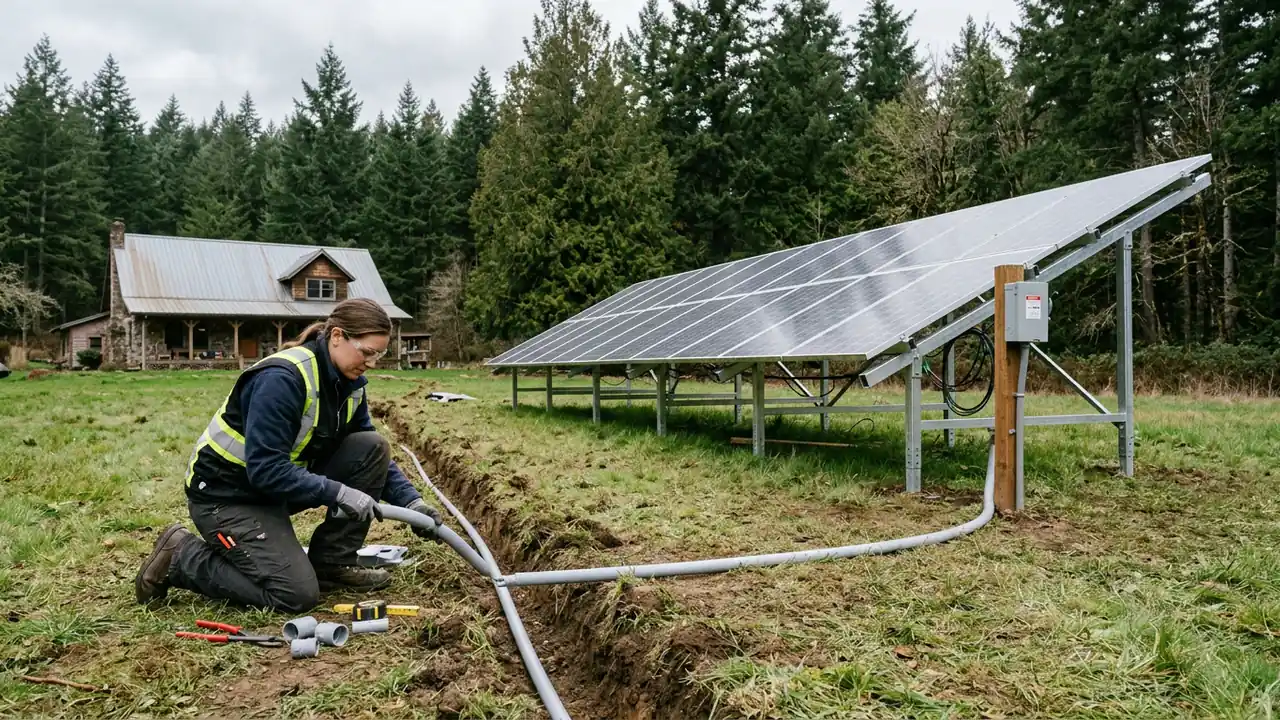
The mount is where a general contractor or a handy owner saves money. IronRidge's ground mount uses 2- or 3-inch steel pipe on concrete piers, ground screws or driven piles, at tilts up to 45 degrees; Tamarack's sets 2-inch pipe in concrete piers. Both are listed to UL 2703 and need a design for your soil, snow and wind. The frame's grounding and bonding counts as electrical work even when the posts do not.
What an EG4 GridBOSS and FlexBOSS system includes
The GridBOSS is a microgrid interconnect device (MID): a 200-amp outdoor box between the utility and the house that switches the home to batteries in an outage. With the Eaton main breaker EG4 specifies, it can serve as the service entrance. It has three inverter ports, a 125A generator input and four smart ports for large loads or AC-coupled solar from any UL 1741 inverter. Signature Solar showed it at about $1,800 to $2,000 on Nov 27, 2026, breakers extra.
The FlexBOSS21 hybrid inverter puts out 16 kW with solar and grid together and 12 kW from batteries alone, at 120/240V split phase. EG4 recommends up to 21 kW of panels across its three MPPT inputs, with a 600-volt maximum, so an 8 kW array leaves room to grow. Its case is NEMA 4X. It sold for about $3,600 on sale at Signature Solar on Nov 27 ($4,199 regular). The FlexBOSS18 is the smaller model: 13 kW out, 18 kW of panels, about $3,200. The full figures are on EG4's FlexBOSS21 spec sheet.
EG4's WallMount batteries are 48-volt lithium iron phosphate units with built-in heaters. The 280Ah models hold 14.3 kWh, and EG4 recommends stopping at 20% charge, which leaves about 11.4 kWh usable from each. The 314Ah All Weather model holds 16 kWh (12.86 kWh usable at EG4's recommendation), is rated IP67 for outdoors and sold for about $3,835 on Nov 27.
One sizing catch: the FlexBOSS21 spec sheet recommends at least 600Ah of battery per inverter. Two 280Ah batteries make 560Ah, just under it; two 314Ah batteries make 628Ah. Washington also requires a home battery system to be listed to UL 9540, and the residential code caps a single unit at 20 kWh and the total at 40 kWh in a utility room or basement, or 80 kWh in a garage or outdoors. Two 16 kWh batteries fit either way, and EG4 publishes UL 9540 certificates for its FlexBOSS and WallMount pairings. Our guide to sizing a home battery covers how many kWh a house needs.
How open is an open system?
EG4's 280Ah battery spec sheets list closed-loop communication with Schneider, Sol-Ark, Victron, Growatt, Luxpower and Deye inverters, so the batteries can outlive the inverter. Not every inverter maker agrees: Sol-Ark's battery integration guide (Rev 7, March 2026) does not list EG4, and Sol-Ark's warranty does not cover damage caused by a battery missing from that guide.
The GridBOSS is the tighter tie. EG4 says third-party inverters cannot connect to its hybrid ports, so replacing the FlexBOSS with another brand later means replacing the GridBOSS too, or bringing the new inverter in through a smart port as AC-coupled solar. Panels and racking are the parts you can truly swap.
The closed systems are closed by contract. Tesla's Powerwall 3 warranty covers only units bought from Tesla or a Tesla certified installer, and only Tesla Certified Installers who are licensed electricians may install it. Enphase batteries are built for Enphase systems; since August 2026 the IQ Battery 10C can join other solar, but only through Enphase installation partners.
Warranty fine print that decides who installs
- No installer requirement at EG4. The GridBOSS, FlexBOSS and WallMount warranties ask for purchase from an EG4-approved vendor and registration within the first year (or proof of purchase), not a certified installer.
- Workmanship is excluded. EG4 does not cover damage from poor workmanship by "an individual, installer, or a firm", so a bad job is on whoever did it.
- Moving the gear voids it. EG4: "Reselling or removing the product from the original installation site will void the warranty." Upgrade by adding batteries, not by moving them.
- Claims go to the seller. EG4 sends warranty claims to the original place of purchase.
- Sol-Ark wants paperwork. Its 15K warranty needs a signed install verification checklist for full coverage.
Can you install your own solar in Washington?
Yes, with conditions. RCW 19.28.261 lets you do electrical work at your own residence, farm or property without a license, unless the work is on a new building meant for rent, sale or lease, or the property is offered for sale within 12 months of buying it. Friends and relatives may help, as long as none of them is in the electrical business. The permit still applies: buy a Labor and Industries electrical permit (from $129.40 for a 0 to 200 amp residential service or feeder) and call for inspection before you bury anything. Inside Port Angeles, the city issues the permit, and its owner form requires you to live in the house for two years after the permit is finalized.
If you hire it out, the company needs a Washington electrical contractor license and its workers electrician certificates; there is no solar specialty. A hired mount builder must be a registered contractor, and the purely structural parts need no electrical permit. Clallam County treats solar as a mechanical permit and wants a scaled site plan and spec sheets; Jefferson County has no solar checklist online, so call its building division first.
Utilities and net metering on the peninsula
Clallam County PUD serves the county outside Port Angeles, and it must approve your interconnection application before you connect. For systems up to 25 kW the application is $100, the new meter $225 and the backfeed test, which your installer attends, $225. Port Angeles holds permits until its net metering agreement is signed, and Jefferson County PUD wants proof of inspection and its written approval before you connect.
State law requires utilities to offer net metering until June 30, 2029, or until net-metered systems reach 4% of the utility's 1996 peak, whichever comes first. In the WSU Energy Program's January 2026 count, Jefferson County PUD stood at 176.5% of that threshold and Clallam County PUD at 88%, and neither had changed its terms. Customers already connected keep net metering while their agreement stays valid, so getting connected sooner matters. Our net metering guide covers other states.
Washington exempts solar equipment for systems up to 100 kW AC from sales tax through 2029; ask the seller whether batteries count. The 30% federal credit ended for systems finished after Dec. 31, 2025, so for taxes it no longer matters who installs (see our 2026 tax credit explainer).
Ground-mount wiring: rapid shutdown and the trench
Rapid shutdown, the rule that lets firefighters de-energize solar wiring, applies to PV circuits on or in buildings. A detached ground array falls outside it, but the DC wires from the array come back under it once they enter the house or garage to reach an indoor inverter. Either keep the DC run outside the building or fit rapid shutdown devices; the FlexBOSS21 supports NEC 690.12 rapid shutdown. Washington enforces the 2023 National Electrical Code now and the 2026 edition for permits issued from Dec. 31, 2026.
Under NEC Table 300.5, buried PVC conduit needs 18 inches of cover, rigid metal conduit 6 inches and direct-burial cable 24 inches. A long run also needs heavier wire to keep voltage drop down, which belongs in the design. Ground mounts cost more per watt: EnergySage's July 2026 figures put them at about $2.96 a watt against $2.60 for all systems, roughly 14% more. Our solar cost breakdown has the wider numbers.
How to hire an electrician for a system you designed
- Have you wired a hybrid inverter with lithium batteries before, and which brands?
- Will you install equipment I buy, and what labor warranty do you give on it?
- Who draws the one-line diagram and pulls the permit?
- How will you handle rapid shutdown and the trench run?
- Will you attend the utility's backfeed or witness test?
- Is the quote labor only, with wire, conduit and breakers listed separately?
NABCEP certification is a voluntary industry credential: a good sign, but not a license to do electrical work.
When a solar company is the better call
Hire a full-service installer if you want one company answerable for design, equipment, permits and service, if your financing only works with approved equipment, or if no local electrician will take customer-supplied gear. If the real goal is backup for a few circuits rather than a full system, a large power station on a transfer switch or smart panel is a much smaller job for an electrician: see how to connect a solar generator to your house and our home backup rankings, or compare costs in solar generator vs DIY inverter and battery.
Frequently Asked Questions
Can an electrician install solar panels?
Yes. In most states, wiring a grid-tied solar and battery system is electrical work, so a licensed electrical contractor can install it with a permit and an inspection. Some states also have limited solar licenses, but a solar company is not required.
Do I need a solar company to install solar panels?
No. A solar company bundles design, equipment, permits and service, but the law usually cares only that the electrical work is done by a licensed electrical contractor or, where allowed, the owner. Many solar companies will not install equipment the customer bought.
Can I install my own solar panels in Washington State?
Yes, on your own home or property under RCW 19.28.261, unless it is a new building meant for rent, sale or lease, or you sell within 12 months of buying the property. You still need a Labor and Industries electrical permit and inspections, and the utility must approve the interconnection before you connect.
Do ground-mounted solar panels need rapid shutdown?
The array on a detached ground mount does not, because NEC 690.12 covers PV circuits on or in buildings. The DC wires come under it once they run into the house or garage to an indoor inverter, so plan where the inverter goes or add rapid shutdown devices.
Does EG4 require a licensed installer for its warranty?
No. EG4's GridBOSS, FlexBOSS and WallMount battery warranties require purchase from an EG4-approved vendor and registration within the first year, not a certified installer. They exclude poor workmanship and are void if the product is removed from its original installation site.
How deep should solar wire from a ground mount be buried?
Under NEC Table 300.5, PVC conduit needs 18 inches of cover, rigid metal conduit 6 inches and direct-burial cable 24 inches, measured from the top of the conduit or cable to finished grade. The inspector checks the trench before it is backfilled.
Is there a federal tax credit for solar panels in 2026?
No. The 30% Residential Clean Energy Credit (Section 25D) ended for systems whose installation was completed after December 31, 2025, whether a pro or the owner installed them. Washington still exempts solar equipment for systems up to 100 kW AC from sales tax through 2029.