Anker SOLIX E10 Review (2026): 7.6kW Whole-Home Backup From $3,999
Table of Contents
Affiliate disclosure: Some links on this page are affiliate links, including links to Amazon, EcoFlow and BLUETTI. If you buy through them we may earn a commission, at no extra cost to you. As an Amazon Associate we earn from qualifying purchases. This never influences our rankings or verdicts.
The Anker SOLIX E10 is a wall- or floor-mounted home battery: a 7,680W, 120/240V inverter that takes one to five 6,144Wh LiFePO4 batteries, 9kW of solar and Anker's tri-fuel generator. It starts at $3,999 with one battery. Buy the $7,799 Power Dock kit (two batteries, automatic 200A whole-home transfer) for hands-off outage backup; skip it if you want a power station with outlets you can carry.
How we evaluated it: Our verdict is based on Anker's E10 user guide, its backup system guide, the Power Dock and Smart Inlet Box manuals, Anker's store and Amazon listings (prices read in mid-November 2026), two independent hands-on reviews (Digital Trends and The Solar Lab), and the runtime arithmetic shown below.
Anker SOLIX E10 with Power Dock and two batteries (12,288Wh)Check price on Amazon
Anker SOLIX E10 review: quick verdict
For whole-home backup with automatic switchover, the E10 is the most complete package we cover at its price. The $7,799 Power Dock kit puts 12,288Wh, 7,680W of continuous 240V power (10,000W for up to 90 minutes), 9kW of solar input and a 200A transfer panel with 12 smart circuits in one order. EcoFlow's DELTA Pro Ultra X costs $7,899 for the same battery capacity and puts out 12kW, but its home panel is another $2,199 to $3,299. The E10's weak spots are software and fixed losses: no screen, an app that tripped up both hands-on reviewers in different ways, and an idle draw measured at about 40W to 46W.
Anker SOLIX E10 specs
| Spec | Value (Anker rating) |
|---|---|
| Battery | B6000 module, 6,144Wh LiFePO4; one to five per power module (30,720Wh); up to three power modules on one Power Dock (92,160Wh, which Anker rounds to 90kWh) |
| Cycle life | 4,000 cycles to 80% capacity (Anker FAQ) |
| AC output | 7,680W (32A) continuous, 120/240V split phase, 60Hz; 10,000W (41.6A) for up to 90 minutes below 86°F with two or more batteries |
| Motor starting (LRA) | 120A with one battery; 155A with two to five; 275A with two or three power modules in parallel, each with two or more batteries |
| Solar input | 9,000W: two MPPT inputs, 4,500W each, 30-450V, 15A operating current per input |
| AC charging | 1,800W from a 120V outlet; 7,680W at 240V; 9,600W (40A) grid or generator pass-through |
| Generator input | 4,500W DC from the Anker SOLIX Smart Generator 5500; third-party AC generators through an adapter |
| Outlets and screen | None on the unit; power goes out through a home panel, a 240V cable to a transfer switch, or a $149 power strip. Status shows on a light bar and in the app |
| Backup switchover | 20ms with the Power Dock; manual with the Smart Inlet Box |
| Weight and size | Power module 60.6 lb, 26.4 x 11.8 x 10.2 in; each battery 130 lb, 26.4 x 12.7 x 11.1 in |
| Enclosure and temperature | NEMA 4 (outdoor rated), -4°F to 131°F |
| Certifications | UL 9540 and UL 9540A, UL 1741 SB, IEEE 1547, among others |
| Warranty | 5 years on the power module and batteries; 10 years on the Power Dock and Smart Inlet Box; 3 years on the Smart Generator 5500 |
Which Anker SOLIX E10 kit to buy
The E10 has no outlets of its own, so the kit you pick decides how it reaches your house. Anker's store and Amazon (sold by AnkerDirect) charged the same for every kit in mid-November 2026; only the loose battery and generator differed.
| Kit | Batteries | Price | How it connects | Cost per kWh |
|---|---|---|---|---|
| E10 starter (Amazon) | 1 (6,144Wh) | $3,999 | Your own transfer switch or the power strip | $651 |
| Smart Inlet Box kit (Amazon) | 1 | $4,299 | Manual, whole panel | $700 |
| Smart Inlet Box kit (Amazon) | 2 (12,288Wh) | $6,299 | Manual, whole panel | $513 |
| Power Dock kit (Amazon) | 1 | $5,799 | Automatic, 200A | $944 |
| Power Dock kit (Amazon) | 2 | $7,799 | Automatic, 200A | $635 |
| Extra B6000 battery (Amazon) | 1 | $2,000 at Anker, $2,299 on Amazon | Stacks under the power module; owners can add it themselves | $326 to $374 |
The kit prices imply the Smart Inlet Box costs $300 and the Power Dock $1,800 over the starter. Here is what each buys you.
- Starter: the power module, one battery and a 240V output cable for an existing generator transfer switch. With no transfer switch, the only way to use it is Anker's $149 power strip (a 14-50 and two 20A outlets, per its Amazon listing), which makes it a very heavy power station.
- Smart Inlet Box: manual backup for one E10. In the installation diagram, an electrician adds a 40A grid breaker and a 50A backup breaker on an interlock in your main panel. In an outage the house goes dark until you flip the interlock and press the E10's power button. Rooftop solar wired to the main panel cannot recharge the E10 through the Inlet Box during an outage (anti-islanding rules, per Anker's guide).
- Power Dock: automatic backup. The Dock becomes the gateway between the meter and your panel, rated 200A (160A continuous), switches to battery in 20ms, manages 12 smart circuits, takes up to three E10s, and has circuits for a generator and an existing solar system.
Our pick is the two-battery Power Dock kit. Two batteries unlock the 10kW turbo and the 155A motor-start rating, and one battery runs an average home for only about four hours. If you can live with flipping a breaker in an outage, the two-battery Smart Inlet Box kit is the value buy at $513 per kWh, $1,500 less for the same capacity.
How long will the Anker SOLIX E10 power a house?
Our standard formula takes about 15% off for inverter losses: runtime (hours) = battery Wh x 0.85 / average load (W). The Solar Lab measured 87% efficiency, so this is close. "Essentials" means a fridge, router, lights and phone charging, about 150W on average; the average US home uses about 29.6kWh a day, or 1,230W around the clock (EIA).
| Batteries | Capacity | Usable (x 0.85) | Essentials (150W) | Average US home (1,230W) |
|---|---|---|---|---|
| 1 | 6,144Wh | 5,222Wh | About 35 hours | About 4 hours |
| 2 | 12,288Wh | 10,445Wh | About 70 hours | About 8.5 hours |
| 5 (one E10, full) | 30,720Wh | 26,112Wh | About 7 days | About 21 hours |
| 15 (three E10s) | 92,160Wh | 78,336Wh | About 22 days | About 2.6 days |
Two things shorten those numbers. The system's own draw was about 40W in The Solar Lab's measurement and about 46W in Digital Trends', roughly 1kWh a day before anything in the house runs; on a light essentials load that is a real share of the total. In freezing weather a battery heater adds about 200W while it runs (Digital Trends). Solar or the generator stretch the numbers the other way: the Smart Generator 5500 ($1,600 at Anker, $1,999 on Amazon) runs on gasoline, propane or natural gas, feeds up to 4,500W of DC straight into the E10 and starts and stops on its own based on battery level. For sizing your own loads, our home battery sizing guide walks through the math.
Performance
AC output and motor starting
Anker's overload table lets the E10 run 100% to 130% of its rating for up to 90 minutes, 130% to 150% for 30 seconds, 150% to 200% for 10 seconds and up to 230% for one second. The Solar Lab ran it at its full 7,600W rating without trouble and saw short bursts near 30kW, and Anker rates a two-battery system at 37.2kW of surge (155A LRA). A 1/2 HP well pump (about 2,000W to start, per our appliance power guide) is easy; see our well pump guide for the rest of that load.
Central air is the load to check. Read the locked-rotor amps (LRA) on your condenser's nameplate and compare it with 120A for one battery or 155A for two or more. Anker's guide adds 20% for compressors over 10 years old: its own example, a 12-year-old unit with a 118A nameplate, works out to about 142A, too much for one battery, so it needs a second battery or a soft starter. One more limit from Anker's backup guide: while a third-party generator is charging the E10, it cannot start a central air conditioner.
Solar charging
Each of the two solar inputs takes up to 4,500W at 30 to 450V and 15A, so the E10 wants long series strings of house-style panels, not the 12V-era portable panels most power stations use. Anker's example puts eleven 405W rigid panels in series on one input (about 411V open circuit, 13.9A), for 4,455W. Two strings like that give the full 9kW, nearly three times the F3800 Plus's 3,200W. With the Power Dock, an existing grid-tied array connects on its own circuits; Anker says the Dock disconnects that array while a third-party generator runs off-grid.
Battery life and cold weather
Anker rates the B6000 at 4,000 cycles to 80%, which is more than ten years at one full cycle a day. The enclosure is rated for -4°F to 131°F, but charging is limited below 59°F and a heating film warms the cells first, which is where Digital Trends' 200W heater figure comes from. Mount it where winter sun or a garage keeps it above freezing if you can.
App and smart features
Everything runs through the Anker app over Wi-Fi or Bluetooth: charge and discharge modes, time-of-use savings, generator control and, with the Power Dock, circuit priorities. Digital Trends praised the layout and said the system kept working without internet once set up, but its batteries did not charge until the reviewer set charging to "Super Off-Peak", which Anker's phone support sorted out. The Solar Lab found solar-priority charging, charge scheduling and runtime estimates incomplete on a standalone E10 and the charge-rate control hidden under a generator setting; Anker told it firmware fixes were coming.
Build quality and design
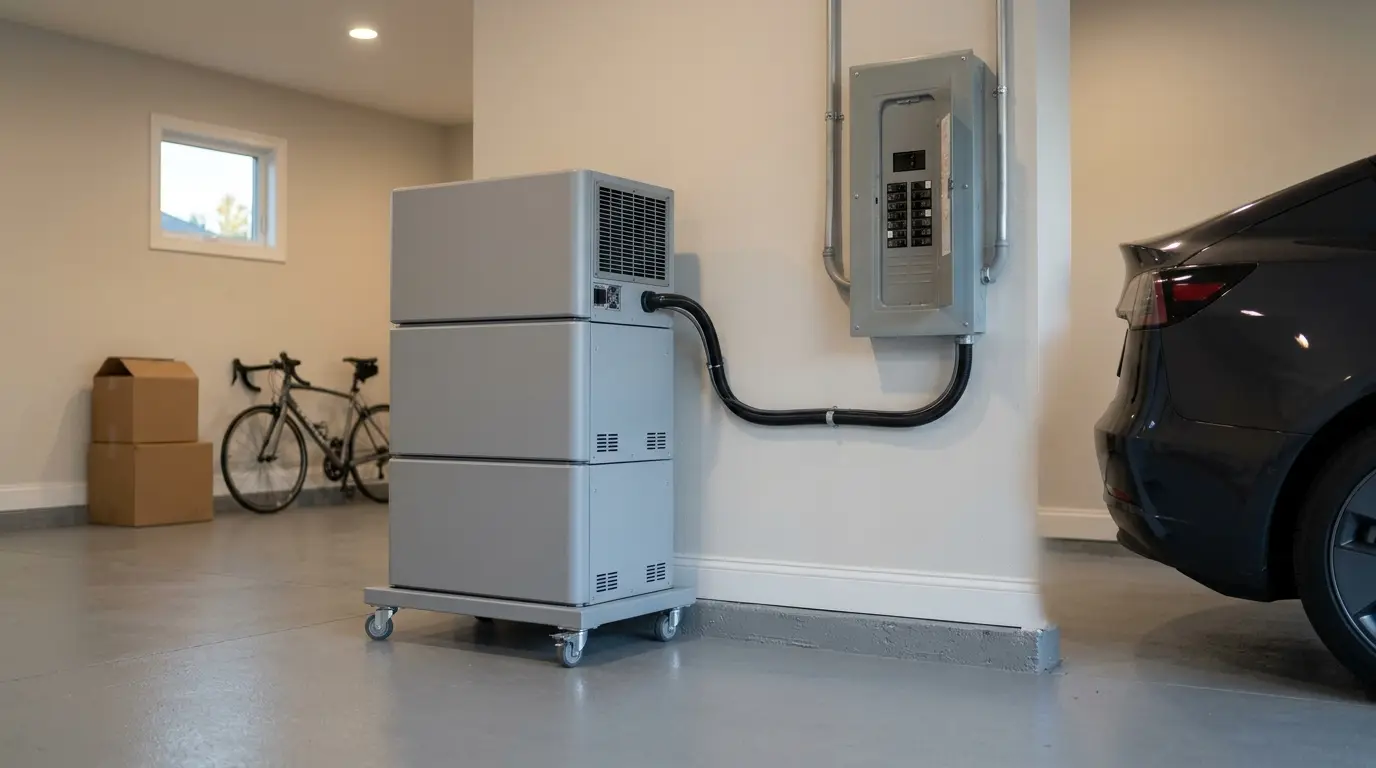
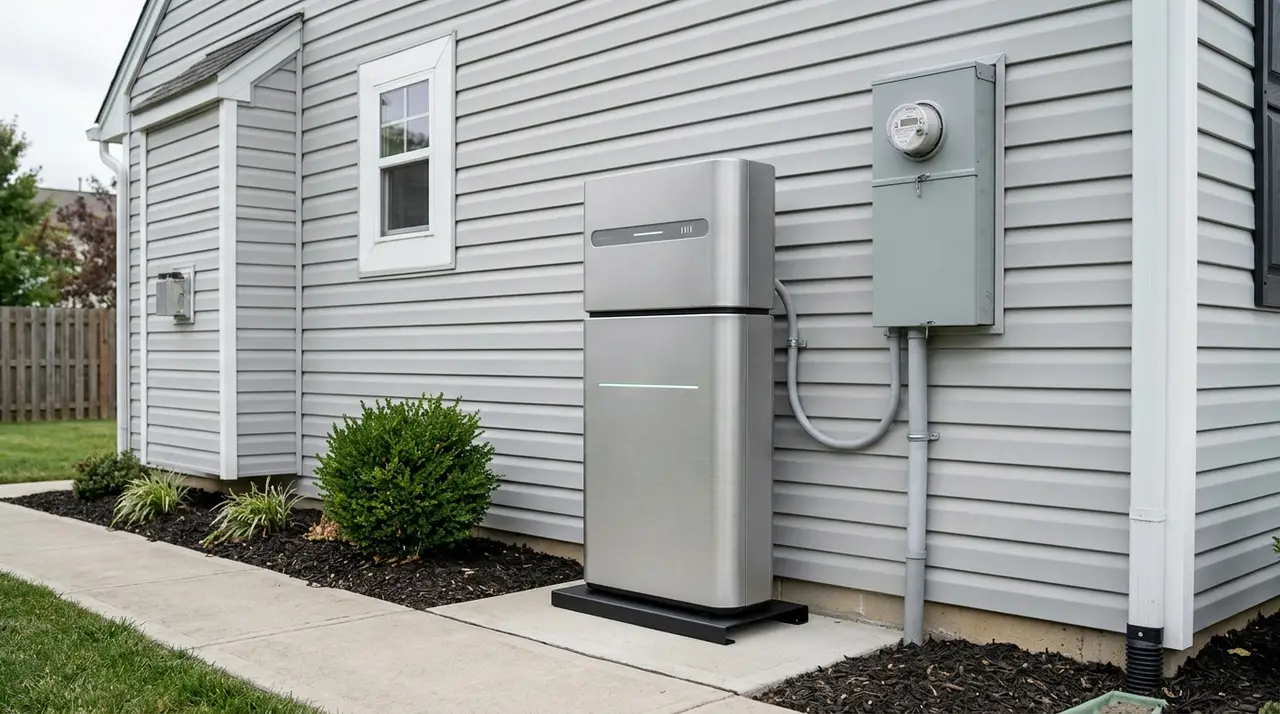
The system stacks: batteries on the bottom, the power module on top, wall- or floor-mounted, indoors or out. Each 130 lb battery is a two-person lift, and The Solar Lab had a plastic battery handle break during handling. The power module and batteries are NEMA 4 and the Power Dock and Inlet Box NEMA 3R, so all of it can sit outside without a shelter, but Anker's manual rules out outdoor installs within 500 m (about 1,640 ft) of the coast because of salt air. Anker recommends wall mounting in flood-prone areas and sells a $249 wall bracket and a $199 raised metal pad (Amazon prices; current Amazon kits include the pad and the AC generator adapter as a promotion). The Smart Generator 5500 must stay outdoors because it makes carbon monoxide, and Digital Trends found its natural gas hose was not included and used a nonstandard connector (about $100 to source).
Anker started selling the E10 in the continental US on February 4, 2026, at $4,299 for the base system, according to ESS News, and offers installation through partner electricians; ESS News reported about five days from purchase to install, depending on permits. Any electrician can do it: Digital Trends' was a local licensed contractor.
What we like
- The $7,799 Power Dock kit includes a 200A automatic transfer panel that rival systems sell separately
- 9kW of high-voltage solar input per power module, 27kW with three
- 7,680W continuous at 240V, 10kW for 90 minutes and a published LRA rating you can check against your air conditioner
- Extra batteries cost about $326 per kWh at Anker and owners can add them without an electrician
- Outdoor-rated NEMA 4 enclosure and a 10-year warranty on the Power Dock and Inlet Box
What we don't like
- No outlets or screen: the starter kit does little without a transfer switch, an Inlet Box or the power strip
- The app had gaps at review time: missing standalone features (The Solar Lab) and a charging setting that needed Anker support to sort out (Digital Trends)
- Idle draw of about 40W to 46W, plus about 200W of battery heating in freezing weather
- One battery limits you to 120A LRA and no 10kW turbo, so the cheapest kits are the weakest
- The power module and batteries get 5 years of warranty, half the 10 years on the Power Dock and Inlet Box
Anker SOLIX E10 vs DELTA Pro Ultra X, DELTA Pro Ultra and F3800 Plus
| Anker SOLIX E10 (Power Dock, 2 batteries) | EcoFlow DELTA Pro Ultra X | EcoFlow DELTA Pro Ultra | Anker SOLIX F3800 Plus with Home Power Panel | |
|---|---|---|---|---|
| Price | $7,799 including the panel | $7,899, plus $2,199 to $3,299 for a home panel | About $4,199 with one battery, plus $1,599 for the Smart Home Panel 2 | $3,199.99 on Amazon |
| Battery | 12,288Wh | 12,288Wh | 6,144Wh | 3,840Wh |
| Continuous output | 7,680W (10kW for 90 min) | 12,000W | 7,200W | 6,000W |
| Solar input | 9,000W | 10,000W | 5,600W | 3,200W |
| Built-in outlets | None | 20A, L14-30 and 14-50 | Yes, including USB | Yes, including USB |
The DELTA Pro Ultra and the F3800 Plus are power stations first: they have outlets and wheels and can leave the house. The E10 cannot, but it beats both on solar input and on what a whole-home setup costs once you add the panel. A Tesla Powerwall 3 runs about $13,500 installed for 13.5kWh (our Powerwall vs generator comparison), so the $7,799 two-battery E10 kit leaves about $5,700 for the electrician before it costs as much, for 1.2kWh less storage.
Who should buy the Anker SOLIX E10
Buy it if you own your home and want the whole panel backed up automatically, you have or plan a large solar array, you get long outages and want a generator that starts itself, or you rely on a well pump. The two-battery Power Dock kit is the one to get; the two-battery Inlet Box kit saves $1,500 if a manual switch is fine.
Skip it if you rent, want something you can take camping, or need more than 7,680W at once from one unit (the DELTA Pro Ultra X does 12kW). If a few circuits are enough, a power station with a transfer switch costs far less: our guide to connecting a power station to your house covers the options, and the Anker SOLIX lineup guide covers Anker's portable models.
Anker SOLIX E10: final verdict
The Anker SOLIX E10 gives you an installed-style home battery at power-station prices: 7,680W at 240V, 9kW of solar, batteries from $326 per kWh and, in the $7,799 kit, a 200A automatic transfer panel that competitors charge thousands for. Its app still needs work and its idle draw is high, but for whole-home outage backup it is the best value we cover. Buy the two-battery Power Dock kit for automatic backup, or the two-battery Smart Inlet Box kit to save $1,500.
Anker SOLIX E10 with Power Dock and two batteries (12,288Wh)Check price on Amazon
Anker SOLIX E10 with Smart Inlet Box and two batteries (12,288Wh)Check price on Amazon
Weighing a bigger battery bank? Our expandable power station guide compares the routes to 10kWh and beyond.
Frequently Asked Questions
Is the Anker SOLIX E10 worth it?
For whole-home outage backup, yes. The $7,799 Power Dock kit includes 12,288Wh of batteries and a 200A automatic transfer panel, while EcoFlow's DELTA Pro Ultra X costs $7,899 for the same capacity before a $2,199 to $3,299 home panel. Skip it if you want a portable power station with outlets, or need more than 7,680W at once from one unit.
How much does the Anker SOLIX E10 cost?
In mid-November 2026 Anker and Amazon both charged $3,999 for the power module with one 6,144Wh battery, $4,299 or $6,299 with the Smart Inlet Box (one or two batteries) and $5,799 or $7,799 with the Power Dock. An extra B6000 battery was $2,000 at Anker and $2,299 on Amazon. Installation by an electrician is extra.
Can the Anker SOLIX E10 run central air?
Usually, if you check the condenser's locked-rotor amps (LRA) first. The E10 is rated for 120A LRA with one battery and 155A with two or more, and Anker's guide adds 20% for compressors over 10 years old. If the result is over the limit, add a battery or a soft starter; and note it cannot start central air while a third-party generator is charging it.
How long will the Anker SOLIX E10 power a house?
One 6,144Wh battery gives about 5,222Wh after inverter losses: about 35 hours of outage essentials (150W) or about 4 hours of an average US home using 29.6kWh a day. Two batteries double that, and five on one E10 run essentials for about a week. The system's own draw of about 40W to 46W comes off those figures.
Do I need an electrician to install the Anker SOLIX E10?
Yes, for the Smart Inlet Box or Power Dock and the connection to your main panel, per Anker. Owners can stack extra battery modules themselves. Anker offers installation through partner electricians, and ESS News reported about five days from purchase to install depending on permits.
What is the difference between the Anker SOLIX E10 and the F3800 Plus?
The F3800 Plus is a 3,840Wh power station on wheels with outlets, 6,000W of output and 3,200W of solar input. The E10 is a fixed, outdoor-rated system with no outlets, 7,680W continuous (10kW for 90 minutes), 9,000W of solar and 6,144Wh batteries that stack to 30,720Wh per unit. Choose the F3800 Plus for a few circuits and portability, the E10 for the whole house.
Can the Anker SOLIX E10 be installed outside?
Yes. The power module and batteries are NEMA 4 rated for -4°F to 131°F, and the Power Dock and Smart Inlet Box are NEMA 3R. Anker's manual rules out outdoor installs within about 1,640 ft (500 m) of the coast because of salt air, and the Smart Generator 5500 must always stay outdoors.
Does the Anker SOLIX E10 qualify for the federal tax credit?
No. The federal Residential Clean Energy Credit (25D), which covered home batteries, ended for systems installed after December 31, 2025, under Public Law 119-21. Check your state and utility for battery rebates instead.