Anker SOLIX Lineup Explained: C vs F vs S Series (2026)
Table of Contents
Affiliate disclosure: Some links on this page are affiliate links, including links to Amazon, EcoFlow and BLUETTI. If you buy through them we may earn a commission, at no extra cost to you. As an Amazon Associate we earn from qualifying purchases. This never influences our rankings or verdicts.
Anker SOLIX sells its US portable power stations in three families: the C series (288Wh to 2,048Wh, carried by hand, 120V), the new S series (so far one model, the 2,010Wh S2000, built for quiet indoor backup) and the F series (2,560Wh to 3,840Wh on wheels, with RV outlets, 240V on the F3800 models and expansion past 26kWh). For most households the picks are the C1000 Gen 2 (about $500) as a 1kWh all-rounder, the S2000 (about $680) for keeping a fridge and router running through an outage, and the F3800 Plus (about $2,600 at Anker) when you need 240V.
Specs below come from each model's page on Anker's US store (ankersolix.com, where anker.com sends SOLIX buyers) and its spec tables, checked September 30, 2026 and re-checked in early October; prices are Amazon US prices on October 9, 2026, except the F2600's, which is Anker's store price. Where Anker does not publish a figure, we say so rather than guess. Our picks are based on published specifications, pricing, warranty terms and owner reports, and prices change often.
Every current Anker SOLIX power station compared
| Model | Series | Price (approx.) | Capacity | AC output (continuous / peak) | Solar input | Weight | Expandable to |
|---|---|---|---|---|---|---|---|
| C300 DC | C | $200 | 288Wh | None (DC and USB-C only, 300W total) | 100W | 6.2 lb | No |
| C300 | C | $330 | 288Wh | 300W / 600W SurgePad | 100W | 9.1 lb | No |
| C800X (with 100W panel) | C | $430 | 768Wh | 1,200W / 1,600W SurgePad | 300W | 24 lb (Anker user guide) | No |
| C1000 | C | $600 ($470 on sale to Oct 14) | 1,056Wh | 1,800W / 2,400W | 600W | 28.4 lb | 2,112Wh (one BP1000) |
| C1000 Gen 2 | C | $500 | 1,024Wh | 2,000W / 3,000W | 600W | 24.9 lb | No |
| S2000 | S | $680 ($650 on sale) | 2,010Wh | 1,500W / 3,000W | 400W | 35.7 lb | No |
| C2000 Gen 2 | C | $1,000 | 2,048Wh | 2,400W / 4,000W | 800W | 41.7 lb | 4,096Wh (one BP2000 Gen 2) |
| F2600 | F | $2,000 (Anker store) | 2,560Wh | 2,400W / 2,800W | 1,000W | 69.7 lb | 5,120Wh |
| F3000 | F | $1,700 | 3,072Wh | 3,600W / 7,200W surge, 120V | 2,400W | 91.5 lb | 12,288Wh per unit |
| F3800 | F | $1,980 | 3,840Wh | 6,000W / 9,000W, 120V and 240V | 2,400W | 132.3 lb | 26.9kWh (53.8kWh with two units) |
| F3800 Plus | F | $2,600 | 3,840Wh | 6,000W (surge not listed), 120V and 240V | 3,200W | 136.7 lb | 26.9kWh (53.8kWh with two units) |
Notes on the table:
- Batteries: every model uses LiFePO4 (LFP) cells. Anker rates most of them at 3,000 to 4,000 cycles; the S2000 is the outlier at 6,000 cycles to 80% (10,000 to 60%).
- Where to buy: the C300 and C300 DC showed "Sold Out" on Anker's store on September 30, 2026 but were in stock on Amazon. The C800X is sold as a bundle with a 100W folding panel. The F2600 is still on Anker's store at $1,999.99, marked "Last Chance", but is hard to justify when the F3000 costs about $600 less.
- UPS switchover (from Anker's pages): 10ms or less on the C300, C1000 Gen 2, S2000 and C2000 Gen 2; 20ms on the F2600, F3800 and F3800 Plus. The C300 DC has no AC, so no UPS.
- Not in the table: the 192Wh C200 DC (DC only, sold out on Anker's store), the older 535 and 536 PowerHouse units, and the E10, a modular whole-home backup system that is installed rather than carried.
What is the difference between the C, S and F series?
Anker does not publish what the letters stand for, so this is our reading of what the models in each family share.
C series (C300 DC to C2000 Gen 2): carry it. Handles, 120V only, a 12V car socket on the C300 models, the C1000s and the C2000 Gen 2, and solar inputs from 100W to 800W. Anker designs them for camping, RVs and short outages; the 1kWh models charge from the wall in under an hour. Only the original C1000 and the C2000 Gen 2 take an expansion battery, and only one.
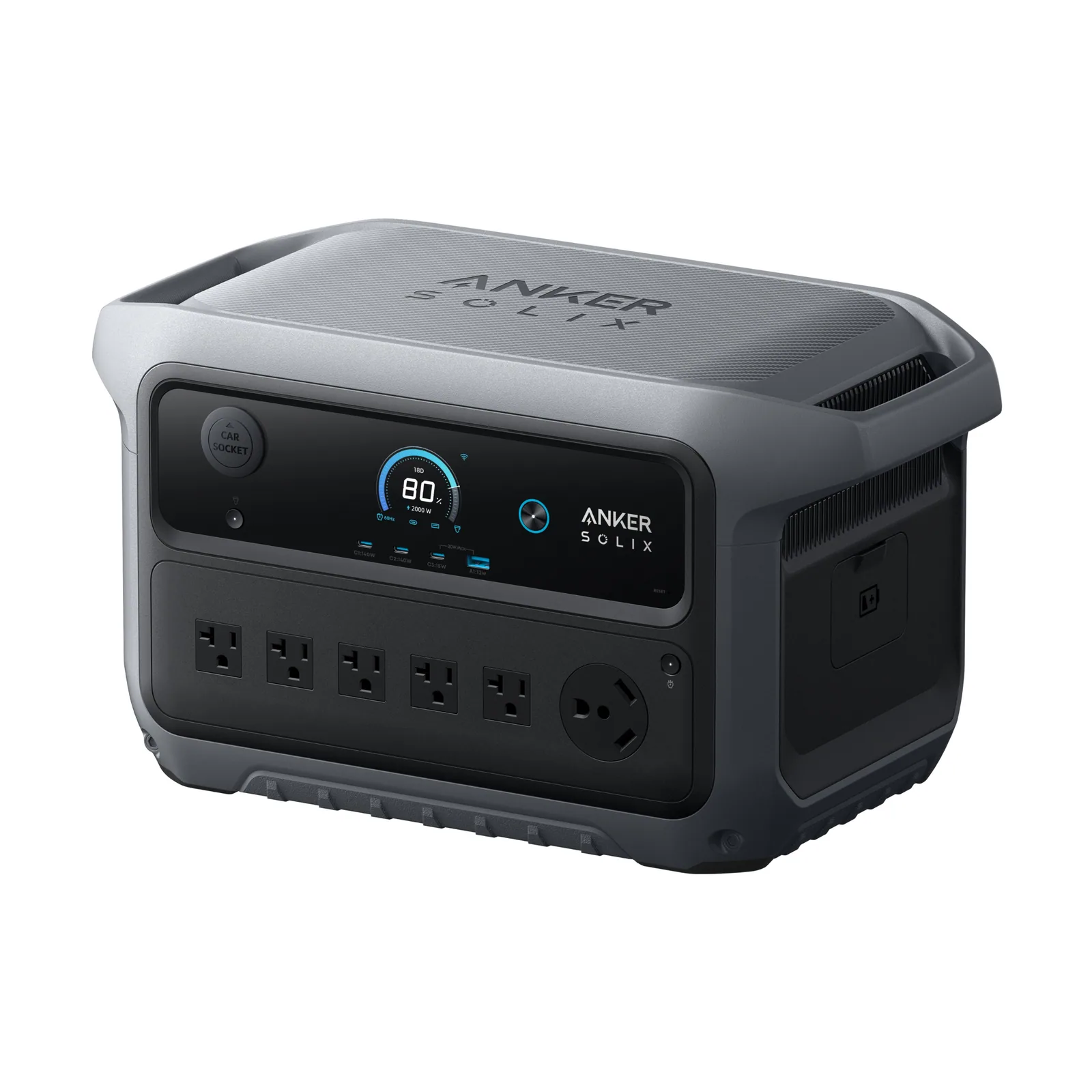
S series (S2000): leave it in the kitchen. Anker pitches the S2000 at indoor essentials: rear outlets for a fridge and router that stay plugged in, a 6W idle draw, a sub-10ms UPS and 314Ah cells rated far beyond the C series. It drops what campers use (no 12V socket) and what expanders want (no extra battery), and at 1,500W it has less output than the C2000 Gen 2. Our Anker SOLIX S2000 review covers the trade-offs.
F series (F2600 to F3800 Plus): roll it. 70 to 136 lb, with wheels on the larger models, a TT-30R RV outlet, high-watt solar (up to 3,200W on the F3800 Plus), expansion batteries and hookups for transfer switches and Anker's home panel. The F3800 and F3800 Plus add true 240V for well pumps, dryers and 240V circuits.
Which Anker SOLIX power station should you buy?
For laptops, cameras and USB-C gear on the go: C300 DC
About $200 for 288Wh, 6.2 lb, three high-power USB-C ports (140W, 140W and 100W) and a 12V socket for a cooler. It has no AC outlets and charges only from USB-C, solar or a car. If you need a wall outlet at the campsite, the $330 C300 adds three; see our C300 and C300 DC review.
For weekend camping with solar: C800X bundle
768Wh, 1,200W and 300W of solar input with a 100W folding panel in the box for about $430, plus built-in camping lights and storage. It replaced the C800, which our C800 review compares it with.
For a 1kWh all-rounder: C1000 Gen 2
1,024Wh, 2,000W (3,000W peak), a 49-minute wall charge in UltraFast mode, 600W of solar and a 10ms UPS in a 24.9 lb box, for about $500. It cannot take an extra battery; if you want to add one later, the original C1000 (about $600, 28.4 lb, 1,800W) accepts a 1,056Wh BP1000 for 2,112Wh. Our C1000 Gen 2 review has the details.
Anker SOLIX C1000 Gen 2Check price on Amazon
For keeping a fridge, router and CPAP running indoors: S2000
2,010Wh for about $680 (about $0.34 per Wh, the lowest in the lineup; Amazon had it at $649.98 in a limited-time deal on October 9, 2026), 35.7 lb, a 10ms UPS and the longest-rated battery Anker sells. About 11 hours on a full-size fridge averaging 150W and several nights of CPAP. Its limits are 1,500W of output and 400W of solar input.
The figures here use planning draws: a conservative 150W average for a full-size fridge (a new ENERGY STAR model averages closer to 63W, so expect longer runtimes) and a conservative 40W for a CPAP (ResMed's battery guide lists about 8 to 20W for an AirSense 10 with its humidifier off, measured through ResMed's 12V DC converter, so expect longer CPAP runtimes than shown, especially from a 12V outlet, and up to about 55W with the humidifier at its highest setting, or about 67W with a heated tube as well).
Anker SOLIX S2000Check price on Amazon
For an RV, or 2kWh with room to grow: C2000 Gen 2
2,048Wh, 2,400W (4,000W peak), 800W of solar, a TT-30R RV outlet and one BP2000 Gen 2 battery for 4,096Wh, at 41.7 lb for about $1,000. It is the C series model that runs a microwave or a hair dryer without complaint. See our C2000 Gen 2 review.
For 120V home circuits: F3000
3,072Wh, 3,600W at 120V, 2,400W of solar across two inputs, 3,600W pass-through charging and BP3000 batteries up to 12,288Wh per unit, for about $1,700. Anker's only route to 240V with it is pairing two units. Our F3000 review covers the generator and panel options.
For 240V (well pump, dryer, whole circuits): F3800 Plus
3,840Wh, 6,000W at 120V and 240V, 3,200W of solar over two 165V inputs, 240V bypass charging from a wall outlet or generator and expansion to 26.9kWh, for about $2,600 at Anker. The plain F3800 (about $1,980) has the same battery, output and expansion but 2,400W of lower-voltage solar; see our F3800 Plus review.
Anker SOLIX F3800 PlusCheck price on Amazon
How long will each Anker SOLIX run a refrigerator?
Runtimes use usable Wh = rated Wh x 0.85 (inverter losses) and runtime in hours = usable Wh / average load in watts, with a full-size fridge averaging 150W, a CPAP at 40W and a 5,000 BTU window AC at 450W. Newer fridges often average under 60W; divide the kWh per day on the EnergyGuide label by 24 to get yours.
| Model | Usable Wh | Full-size fridge (150W) | CPAP (40W) | Window AC (450W) |
|---|---|---|---|---|
| C300 | about 245 | about 1.6 hours | about 6.1 hours | No (over 300W) |
| C800X | about 653 | about 4.4 hours | about 16.3 hours | about 1.5 hours |
| C1000 | about 898 | about 6.0 hours | about 22.4 hours | about 2.0 hours |
| C1000 Gen 2 | about 870 | about 5.8 hours | about 21.8 hours | about 1.9 hours |
| S2000 | about 1,709 | about 11.4 hours | about 42.7 hours | about 3.8 hours |
| C2000 Gen 2 | about 1,741 | about 11.6 hours | about 43.5 hours | about 3.9 hours |
| F2600 | about 2,176 | about 14.5 hours | about 54.4 hours | about 4.8 hours |
| F3000 | about 2,611 | about 17.4 hours | about 65.3 hours | about 5.8 hours |
| F3800 / F3800 Plus | about 3,264 | about 21.8 hours | about 81.6 hours | about 7.3 hours |
The C300 DC has no AC, so it cannot run a household fridge; on a CPAP with a 12V DC cord it matches the C300's 6.1 hours or better. Expansion batteries add runtime in proportion: a C2000 Gen 2 with its BP2000 Gen 2 (4,096Wh) runs the same fridge about 23 hours, and an F3800 Plus with one BP3800 about 43.5 hours.
C1000 vs C1000 Gen 2: which should you buy?
The Gen 2 for most people. It has 200W more output (2,000W against 1,800W), a higher 3,000W peak (against 2,400W), a faster 1,600W UltraFast wall charge and weighs 3.5 lb less (24.9 against 28.4 lb). The original C1000 keeps two advantages: 32Wh more capacity and a port for the 1,056Wh BP1000 expansion battery, which takes it to 2,112Wh. At the same regular price of about $600 (Anker had the C1000 at $469.99 in a sale ending October 14, 2026), pick the C1000 only if you know you will add that battery.
S2000 vs C2000 Gen 2: is the S series better?
Better for a different job. The S2000 costs about $320 less, weighs 6 lb less and quotes 6,000 cycles to 80% against the C2000 Gen 2's 4,000. The C2000 Gen 2 has 900W more output, twice the solar input, a TT-30R RV outlet, a 12V socket and an expansion battery. For home outage backup of the fridge and internet, the S2000 is the better buy; for an RV, a van or high-watt appliances, the C2000 Gen 2 is.
F3800 vs F3800 Plus: what is the difference?
Solar and charging. Both have 3,840Wh, 6,000W at 120V and 240V, and the same expansion to 26.9kWh with BP3800 batteries. The Plus takes 3,200W of solar across two high-voltage (11-165V) inputs, against the F3800's 2,400W across two 60V inputs, and Anker markets 240V bypass charging from a 240V wall outlet or generator for it (6,000W of bypass), with a dedicated 240V charging cable. The Plus weighs about 4 lb more and costs about $420 more. Long panel runs and high-voltage strings favor the Plus; if you will charge mostly from the wall, the F3800 saves the money.
Which Anker SOLIX models are discontinued?
The C800 has been replaced by the C800X (the C800 now appears on Anker's US store only as a refurbished unit), and the F2000, also sold as the PowerHouse 767, is gone from Amazon US; its closest current replacement is the C2000 Gen 2, which keeps 2,048Wh and 2,400W in a case about 25 lb lighter. Our F2000 review is still up for owners and anyone weighing a leftover unit.
Frequently Asked Questions
What is the difference between the Anker SOLIX C, S and F series?
The C series (288Wh to 2,048Wh) is carried by hand and runs 120V. The S series, so far only the 2,010Wh S2000, is built for quiet indoor backup of fridges, routers and medical devices. The F series (2,560Wh to 3,840Wh) is heavy home backup with RV outlets, expansion batteries and, on the F3800 models, 240V.
Which Anker SOLIX is best for home backup?
The S2000 (about $680) for a fridge, router and CPAP; the F3000 (about $1,700) for 120V circuits; and the F3800 Plus (about $2,600 at Anker) if you need 240V for a well pump or dryer.
Which Anker SOLIX power stations are expandable?
The C1000 (to 2,112Wh), C2000 Gen 2 (to 4,096Wh), F2600 (to 5,120Wh), F3000 (to 12,288Wh per unit) and the F3800 and F3800 Plus (to 26.9kWh per unit). The C300, C300 DC, C800X, C1000 Gen 2 and S2000 are not expandable.
Which Anker SOLIX has 240V output?
The F3800 and F3800 Plus, which output 120V and 240V from one unit. The F3000 reaches 240V only when two units are paired.
What is the cheapest Anker SOLIX power station?
The C300 DC at about $200, but it has no AC outlets. The cheapest with AC outlets is the C300 at about $330. At 1kWh, the C1000 Gen 2 was $499.99 at Anker and on Amazon on October 30, 2026 (Anker lists it at $699.99).
What is the lightest 2kWh Anker SOLIX?
The S2000 at 35.7 lb, against 41.7 lb for the C2000 Gen 2.
Is the Anker C1000 Gen 2 better than the C1000?
For most buyers, yes: 2,000W against 1,800W, a 3,000W peak and 3.5 lb less weight. The original C1000 is the one to buy only if you want to add its 1,056Wh BP1000 expansion battery.
Do all Anker SOLIX power stations use LiFePO4 batteries?
Yes. Every current model uses LiFePO4 cells, rated at 3,000 to 4,000 cycles on most models and 6,000 cycles to 80% on the S2000.