EcoFlow RIVER 3 Plus Review (2026): vs RIVER 3 and Max
Table of Contents
Affiliate disclosure: Some links on this page are affiliate links, including links to Amazon, EcoFlow and BLUETTI. If you buy through them we may earn a commission, at no extra cost to you. As an Amazon Associate we earn from qualifying purchases. This never influences our rankings or verdicts.
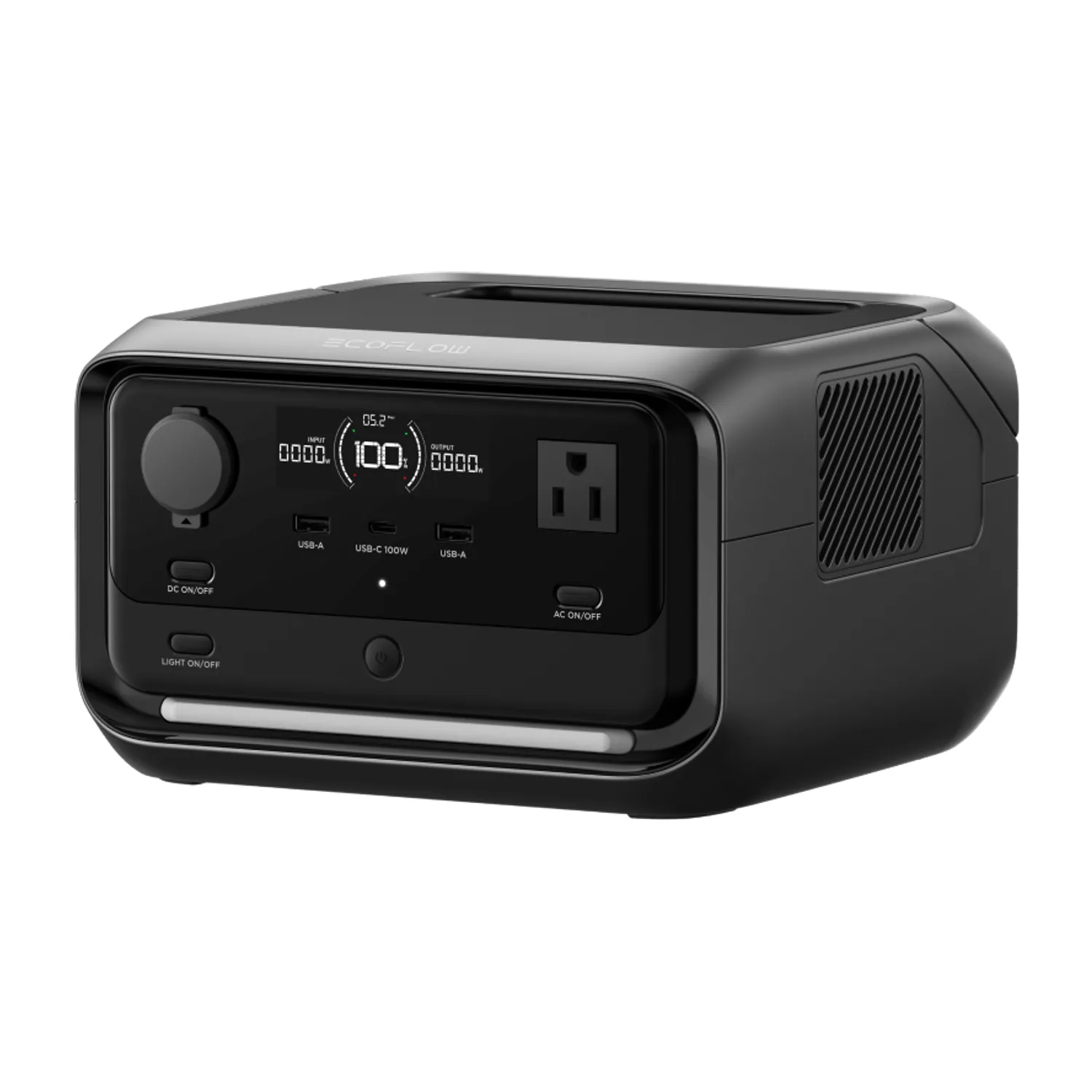
The EcoFlow RIVER 3 Plus is a 286Wh LiFePO4 power station with 600W of AC output (1,200W X-Boost), a switchover EcoFlow rates at under 10ms and a one-hour wall charge for $299 on EcoFlow's US store. For most buyers the better deal is the $319 RIVER 3 Max: the same RIVER 3 Plus sold with a 286Wh Extra Battery 300, so 572Wh for $20 more. The smaller RIVER 3 (245Wh, 300W) is the budget option at about $249.
This EcoFlow RIVER 3 Plus review is based on EcoFlow's published US specifications, pricing and warranty terms. Runtimes are arithmetic, and the formula is shown below. EcoFlow prices were checked on its US store on September 30, 2026, and they change often.
EcoFlow RIVER 3 PlusBuy at EcoFlow
EcoFlow RIVER 3 Plus specs
| Spec | EcoFlow RIVER 3 Plus |
|---|---|
| Capacity | 286Wh |
| Battery | LiFePO4 (LFP), 3,000 cycles to 80% capacity; IP54-rated battery pack |
| AC output | 3 outlets (1 front, 2 rear), 600W total, 1,200W surge, 1,200W X-Boost (120V) |
| USB-C | 1 port, 100W |
| USB-A | 2 ports, 12W each (24W total) |
| 12V DC | Car socket (shown on EcoFlow's product photos; no rating on its US spec table) |
| AC charging | 380W: 0-100% in 60 minutes |
| Solar input | 220W: 0-100% in as little as 1.5 hours |
| Car charging | 0-100% in 3.3 hours |
| Generator charging | 380W: 0-100% in 60 minutes |
| UPS switchover | Under 10ms |
| Noise | Under 30dB at 1.5 ft (EcoFlow lab figure) |
| Expansion | One Extra Battery 300 (286Wh) or Extra Battery 600 (572Wh), up to 858Wh |
| Other | Built-in light; PC and NAS data interface for low-battery alerts and auto-save |
| Weight | 10.4 lb |
| Dimensions | 9.2 x 9.1 x 5.8 in |
| Temperature | Discharge 14°F to 113°F; charge 32°F to 113°F |
| Warranty | 5 years |
| Price | About $299 ($279 in an EcoFlow flash sale on October 12, 2026) |
Source: EcoFlow's US RIVER 3 Plus page and EcoFlow's warranty policy, checked September 30, 2026. EcoFlow notes that the IP54 rating covers the battery pack only, not the whole unit, and that the noise figure was measured at 89.6°F in its lab.
Is the RIVER 3 Max just a RIVER 3 Plus with an extra battery?
Yes. EcoFlow's US store lists it as "RIVER 3 Max (RIVER 3 Plus + Extra Battery 300)", its spec table is the RIVER 3 Plus's, and the Amazon listing's box contents are a RIVER 3 Plus, an EB300 extra battery, AC and car charging cables and a USB-B to USB-A UPS communication cable. The Extra Battery 300 clips onto the station through pogo pins, with no cables or screws:
| Extra battery | Capacity | Weight | Own port | Price alone (EcoFlow) | Total with RIVER 3 Plus |
|---|---|---|---|---|---|
| Extra Battery 300 (included in the Max) | 286Wh | 7.7 lb | USB-C, 140W in and out | $159 | 572Wh |
| Extra Battery 600 | 572Wh | 12.8 lb | USB-C, 140W in and out | $249 (listed as sold out on September 30, 2026) | 858Wh |
The pricing is what makes the Max the pick. Bought separately at EcoFlow, a RIVER 3 Plus and an Extra Battery 300 cost $458; as the Max they cost $319, so the second battery effectively costs $20. The station takes one extra battery at a time, so the 858Wh ceiling needs the Extra Battery 600 in place of the 300. The extra battery also works on its own as a 7.7 lb USB-C power bank for phones, tablets and laptops that charge at up to 140W. EcoFlow's warranty page also lists a RIVER 3 Max Plus, and Amazon sells one rated 858Wh, which matches the Plus with the Extra Battery 600 (our inference; EcoFlow's US store does not sell it).
EcoFlow RIVER 3 MaxBuy at EcoFlowCheck price on Amazon
RIVER 3 vs RIVER 3 Plus vs RIVER 3 Max: what's the difference?
| Spec | RIVER 3 | RIVER 3 Plus | RIVER 3 Max |
|---|---|---|---|
| Price (approx.) | $249 (Amazon) | $299 (EcoFlow) | $319 (EcoFlow) |
| Capacity | 245Wh | 286Wh | 572Wh (2 x 286Wh) |
| Cycle rating | 3,000+ cycles | 3,000 to 80% | 3,000 to 80% |
| AC output | 300W (600W X-Boost) | 600W (1,200W surge and X-Boost) | 600W (1,200W surge and X-Boost) |
| AC outlets | 2 | 3 | 3 |
| Other outputs | 2 USB-A, 1 USB-C, car socket | 2 USB-A, 1 x 100W USB-C, car socket | Same, plus a 140W USB-C on the battery |
| Total outputs | 6 | 7 | 8 |
| Wall charge, 0-100% | 1 hour (320W) | 1 hour (380W) | Not published for the pair |
| Solar input | 110W: about 2.6 hours | 220W: as little as 1.5 hours | 220W |
| Car charging | 2.8 hours | 3.3 hours | Not published |
| UPS switchover | Under 20ms | Under 10ms | Under 10ms |
| Expandable | No expansion listed | Yes, to 858Wh | Yes, to 858Wh with the EB600 swapped in |
| Weight | 7.8 lb | 10.4 lb | 18.1 lb in two pieces (10.4 + 7.7 lb) |
| Dimensions | 10 x 8.3 x 4.4 in | 9.2 x 9.1 x 5.8 in | Plus stacked on a 9.2 x 8.8 x 4.3 in battery |
| Warranty | 2 years | 5 years | 5 years |
EcoFlow's US store does not sell the RIVER 3, so its specs come from EcoFlow's Amazon US listing and the spec graphics on it; its 2-year warranty is from EcoFlow's warranty page. Amazon's listing titles quote "550W" for the RIVER 3, "760W" for the RIVER 3 Plus and "990W" for the RIVER 3 Max. Those figures match neither EcoFlow's AC ratings nor its X-Boost figures, so we use EcoFlow's numbers.
Two differences matter most. First, output: the RIVER 3's 300W limit rules out a window AC and small kitchen appliances, and the Plus doubles it. Second, the Plus and Max take an extra battery while the RIVER 3 lists no expansion, so the Plus is the one you can grow. EcoFlow markets all three with its X-GaNPower claim of up to twice the runtime on loads under 100W; its footnotes say that figure comes from lab tests with 3W lights or routers, compared with an unnamed "industry standard" unit.
Which RIVER 3 should you buy?
Buy the RIVER 3 Max (most people)
For $20 over the Plus you get double the energy, which is the difference between a CPAP lasting part of a night and lasting a night and a half, or a mini fridge running about 4 hours instead of about 8. You also keep the flexibility of the Plus: leave the battery home for a day trip, or use it alone as a USB-C power bank. It is the pick for camping weekends, CPAP, apartment backup and a home office UPS.
EcoFlow RIVER 3 MaxBuy at EcoFlowCheck price on Amazon
Buy the RIVER 3 Plus only if 10.4 lb is the limit
The Plus alone makes sense if you already own an Extra Battery, want the smallest unit that still delivers 600W and a sub-10ms UPS, or will only ever run a router, modem and laptop. Because the Max costs only $20 more, buying the Plus alone saves little.
EcoFlow RIVER 3 PlusBuy at EcoFlow
Buy the RIVER 3 if you only charge devices
At 7.8 lb and about $249, the RIVER 3 is for phones, cameras, drones, laptops and a light at the campsite. It carries a 2-year warranty instead of 5, a slower 20ms switchover and no expansion, and its 300W output is its real limit. If you need 600W or a full night of CPAP, spend the extra $70 on the Max.
EcoFlow RIVER 3Check price on Amazon
How long will the RIVER 3 Plus run a CPAP, fridge and other appliances?
Runtime estimates use usable Wh = rated Wh x 0.85 (inverter and conversion losses) and runtime in hours = usable Wh / average load in watts. That gives about 208 usable Wh for the RIVER 3, 243 for the RIVER 3 Plus and 486 for the RIVER 3 Max.
The figures here use planning draws: a conservative 150W average for a full-size fridge (a new ENERGY STAR model averages closer to 63W, so expect longer runtimes) and a conservative 40W for a CPAP (ResMed's battery guide lists about 8 to 20W for an AirSense 10 with its humidifier off, measured through ResMed's 12V DC converter, so expect longer CPAP runtimes than shown, especially from a 12V outlet, and up to about 55W with the humidifier at its highest setting, or about 67W with a heated tube as well).
| Appliance | Average load | RIVER 3 (245Wh) | RIVER 3 Plus (286Wh) | RIVER 3 Max (572Wh) |
|---|---|---|---|---|
| CPAP | 40W | about 5.2 hours | about 6.1 hours | about 12.2 hours |
| Mini fridge | 60W | about 3.5 hours | about 4.1 hours | about 8.1 hours |
| Full-size refrigerator (cycling) | 150W | about 1.4 hours | about 1.6 hours | about 3.2 hours |
| Wi-Fi router | 10W | about 21 hours | about 24 hours | about 49 hours |
| Laptop | 60W | about 3.5 hours | about 4.1 hours | about 8.1 hours |
| 55" LED TV | 100W | about 2.1 hours | about 2.4 hours | about 4.9 hours |
| 12V cooler | 45W | about 4.6 hours | about 5.4 hours | about 10.8 hours |
| Window AC (5,000 BTU) | 450W | Over the 300W rating | about 32 minutes | about 1.1 hours |
| Sump pump, 1/3 HP (running) | 800W | Over the rating | Over the 600W rating | Over the 600W rating |
| Space heater | 1,500W | Over the rating | Over the rating | Over the rating |
Treat these as best case. EcoFlow's own spec graphic for the RIVER 3 lists 4.6 hours for a 40W CPAP and 3.4 hours for a 60W laptop, a little under our 5.2 and 3.5 hours. At the other end, very small AC loads run for less time than the formula suggests, because the inverter draws power of its own: EcoFlow quotes up to 35 hours for a 3W router on the RIVER 3 Plus, where 243 usable Wh divided by 3W would suggest 81. With the Extra Battery 600 fitted (858Wh, about 729 usable Wh), a full-size fridge runs about 4.9 hours and a CPAP about 18 hours. Our runtime cheat sheet has the same math for larger stations.
Can the RIVER 3 Plus run a CPAP through the night?
Not quite on its own, if your machine averages 40W. The RIVER 3 Plus covers about 6.1 hours, short of an eight-hour night; the RIVER 3 Max covers about 12.2 hours, a night and a half. Some machines draw less than 40W with the humidifier off, so check your own machine's power figure before deciding, and remember a heated humidifier adds a lot to the draw. Running the CPAP from the car socket with the maker's 12V DC cord, where one exists, avoids the inverter losses in our 0.85 factor. EcoFlow rates the RIVER 3 series under 30dB at 1.5 ft, which suits a bedroom or tent. Our best solar generators for CPAP guide compares larger options for multi-night trips.
Is the RIVER 3 Plus good for apartment and home office backup?
Yes, and this is the job it is designed around. EcoFlow rates the switchover at under 10ms and puts two of the three AC outlets on the back so cables stay hidden, like a desktop UPS. Its data interface works with EcoFlow's software to alert a PC or NAS and save work when the battery runs low, and the Max ships with the USB-B to USB-A cable for it. A router and modem (about 20W together) plus a 60W laptop is an 80W load: about 3 hours on the Plus and about 6 hours on the Max. EcoFlow's own example is a 600W computer running at least 21 minutes on the Plus, enough to save and shut down. For renters without a balcony for solar, our best solar generators for apartments covers what works indoors.
What can't the RIVER 3 Plus run?
- Space heaters. A 1,500W heater is 2.5 times the rated output. X-Boost runs heating appliances up to 1,200W at reduced power, but 243 usable Wh would last about 12 minutes at that draw.
- Microwaves. Most draw 1,000W or more from the wall; the 600W inverter is not built for them.
- Window AC for long. A 5,000 BTU unit averaging 450W fits the rating, but it empties the Plus in about 32 minutes and the Max in about 1.1 hours.
- Sump pumps, full-size fridges for a day, power tools with big motors. An 800W pump is over the rating, and a fridge gets under 2 hours on the Plus alone.
X-Boost lowers the voltage it supplies so a heating appliance draws less than its rated watts: a hair dryer or kettle runs, but cooler or slower than on a wall outlet. For outage loads of that size, look at a 1kWh station with an 1,800W inverter instead.
How long does the RIVER 3 Plus take to charge?
EcoFlow rates the RIVER 3 Plus at 0-100% in 60 minutes from a wall outlet or a generator (380W), 3.3 hours from a car and as little as 1.5 hours from 220W of solar. EcoFlow does not publish charge times for the two-battery Max, so its column below is the same arithmetic at 572Wh; at the 380W wall input, the Max cannot refill in less than about 1.5 hours (572 / 380). The Extra Battery can also be charged on its own through its 140W USB-C port.
| Solar setup | RIVER 3 Plus: best case | RIVER 3 Plus: at 70% of rating | RIVER 3 Max: best case | RIVER 3 Max: at 70% of rating |
|---|---|---|---|---|
| 45W panel | about 6.4 hours | about 9.1 hours | about 12.7 hours | about 18.2 hours |
| 100W panel | about 2.9 hours | about 4.1 hours | about 5.7 hours | about 8.2 hours |
| 160W panel | about 1.8 hours | about 2.6 hours | about 3.6 hours | about 5.1 hours |
| 220W panel (the input limit) | about 1.3 hours | about 1.9 hours | about 2.6 hours | about 3.7 hours |
These are hours of strong sun. A 100W panel refills the Plus in a good day but needs a second day for the Max; a 160W or 220W panel handles the Max in one. EcoFlow sells a 45W folding USB-C panel for the RIVER 3 Plus that packs to laptop size, but at 45W it is a top-up, not a daily recharge. Our guide to how many solar panels you need covers sizing.
RIVER 3 Plus vs Jackery Explorer 300 vs Anker SOLIX C300
| Spec | EcoFlow RIVER 3 Plus | Jackery Explorer 300 | Anker SOLIX C300 |
|---|---|---|---|
| Price (approx.) | $299 | $289 | Listed as sold out on Anker's US store (September 30, 2026) |
| Capacity | 286Wh, expandable to 858Wh | 292Wh | 288Wh |
| AC output | 600W (1,200W surge) | 300W (600W surge) | 300W (600W surge) |
| AC outlets | 3 | 2 | 3 |
| USB-C | 1 x 100W | 1 x 100W | 2 x 140W, 1 x 15W |
| USB-A | 2 | 2 | 1 |
| Car socket | Yes | 120W | 120W |
| Wall charging | 0-100% in 60 minutes | Not stated on the listing | 0-80% in 50 minutes |
| Solar input | 220W | 80% in about 2.8 h from a 100W panel | 100W max |
| UPS switchover | Under 10ms | Not stated on the listing | 10ms |
| Cycle rating | 3,000 to 80% | 4,000 to 70% | 3,000+ to 80% |
| Weight | 10.4 lb | 7.5 lb | 9.1 lb |
| Warranty | 5 years | 2 years | 5 years |
Jackery specs are from its Amazon US listing, the model our buy box links to; Jackery's own store sells a similar Explorer 300 v2 rated at 288Wh and 8.1 lb, so check which version a listing is. Anker specs are from Anker's US C300 page. All three hold about the same energy. The RIVER 3 Plus has twice the AC output of either rival, a 220W solar input (the Anker takes 100W) and the only expansion path, which is why it costs more than the Jackery. The Jackery is the lightest at 7.5 lb and about $10 cheaper, the one to carry if you only charge devices. The Anker's two 140W USB-C ports suit laptop-heavy users, if you can find one in stock.
Jackery Explorer 300 (LiFePO4)Check price on Amazon
RIVER 3 Plus vs RIVER 2 Pro: which is better value?
If you need energy more than you need a fast UPS, the older RIVER 2 Pro is the better value: 768Wh, 800W and four AC outlets for about $369 at EcoFlow (sold out on October 12; $389 on Amazon), against 572Wh and 600W for the $319 RIVER 3 Max. It weighs 18.2 lb in one piece, and its switchover is rated under 30ms rather than under 10ms. Our EcoFlow RIVER 2 Pro review runs the full comparison.
EcoFlow RIVER 2 ProBuy at EcoFlowCheck price on Amazon
RIVER 3 Plus pros and cons
Pros
- 600W output and a 1,200W X-Boost in a 10.4 lb body
- Switchover rated under 10ms, with rear outlets and PC/NAS alerts for a desk setup
- One-hour wall charge and a 220W solar input
- Expands to 572Wh or 858Wh with a clip-on battery that doubles as a USB-C power bank
- Rated under 30dB, LFP cells for 3,000 cycles and a 5-year warranty
Cons
- 286Wh alone is short of a full night for a 40W CPAP
- Costs only $20 less than the RIVER 3 Max, which has twice the capacity
- About $1.05 per Wh on its own, against about $0.45 for the RIVER 2 Pro
- EcoFlow's US spec table leaves out the car socket's rating
EcoFlow RIVER 3 Plus review: final verdict
The RIVER 3 Plus is a well-designed small station with a switchover rated under 10ms, a quiet rating and a clean expansion path. At current EcoFlow prices, though, buying it alone makes little sense: the RIVER 3 Max is the same station with a second 286Wh battery for $20 more. Buy the Max for camping, CPAP and apartment backup, buy the RIVER 3 only if you just charge devices, and buy the RIVER 2 Pro if raw capacity per dollar matters more than the UPS.
EcoFlow RIVER 3 MaxBuy at EcoFlowCheck price on Amazon
To compare the RIVER 3 line with the larger DELTA units, see every EcoFlow power station compared.
Frequently Asked Questions
Is the RIVER 3 Max the same as the RIVER 3 Plus?
Yes, with a second battery. EcoFlow's US store sells the RIVER 3 Max as "RIVER 3 Plus + Extra Battery 300": the same 286Wh, 600W station with a clip-on 286Wh battery, 572Wh in total, for about $319 against $299 for the Plus alone.
What is the difference between the RIVER 3 and the RIVER 3 Plus?
The Plus has 286Wh instead of 245Wh, 600W of output instead of 300W, three AC outlets instead of two, a 220W solar input instead of 110W, a switchover rated under 10ms instead of under 20ms, expansion to 858Wh and a 5-year warranty instead of 2 years. The RIVER 3 is lighter (7.8 lb against 10.4 lb) and about $50 cheaper.
How long will the RIVER 3 Plus run a CPAP?
About 6.1 hours for a CPAP averaging 40W (286 x 0.85 / 40), short of a full eight-hour night. The RIVER 3 Max covers about 12.2 hours, a night and a half.
Is the EcoFlow RIVER 3 Plus expandable?
Yes. It takes one extra battery at a time: the 286Wh Extra Battery 300 (572Wh in total, $159 on its own) or the 572Wh Extra Battery 600 (858Wh in total). Both clip on with pogo pins and each has its own 140W USB-C port.
How long does the RIVER 3 Plus take to charge?
EcoFlow rates it at 0-100% in 60 minutes from a wall outlet or generator (380W), as little as 1.5 hours from 220W of solar and 3.3 hours from a car. EcoFlow does not publish charge times for the two-battery RIVER 3 Max.
Can the RIVER 3 Plus work as a UPS for a computer?
Yes. EcoFlow rates the switchover at under 10ms, puts two AC outlets on the back and includes a PC/NAS data interface that sends alerts and saves work when the battery runs low. EcoFlow says it runs a 600W computer for at least 21 minutes.
Can the RIVER 3 Plus run a refrigerator?
Briefly. A full-size fridge averaging a conservative 150W runs about 1.6 hours on the Plus and about 3.2 hours on the RIVER 3 Max; a 60W mini fridge runs about 4.1 and 8.1 hours.
What can't the RIVER 3 Plus run?
Space heaters, most microwaves, sump pumps and anything else over 600W continuous. X-Boost runs heating appliances up to 1,200W at reduced power for short stretches, and a 5,000 BTU window AC averaging 450W empties it in about 32 minutes.