Best Solar Generators for Hurricane Season 2026
Table of Contents
For hurricane preparedness, the EcoFlow DELTA Pro is the right generator for most households. At 3600Wh with 3600W output and 1600W solar input, it covers 11+ hours of essential loads on a single charge and recharges in a single good solar day — the fundamental requirement for multi-day storm outages. A 1024Wh unit lasts 3.2 hours on a standard essential load. That's fine for a summer thunderstorm; it's inadequate for a Category 3 hurricane that leaves your neighborhood without power for 5-7 days.
This guide is specific to hurricane scenarios: extended outages of 3-7 days, probable cloud cover limiting solar recharge, and the need to prioritize essential loads for the duration.
Why 1000Wh Falls Short for Hurricanes
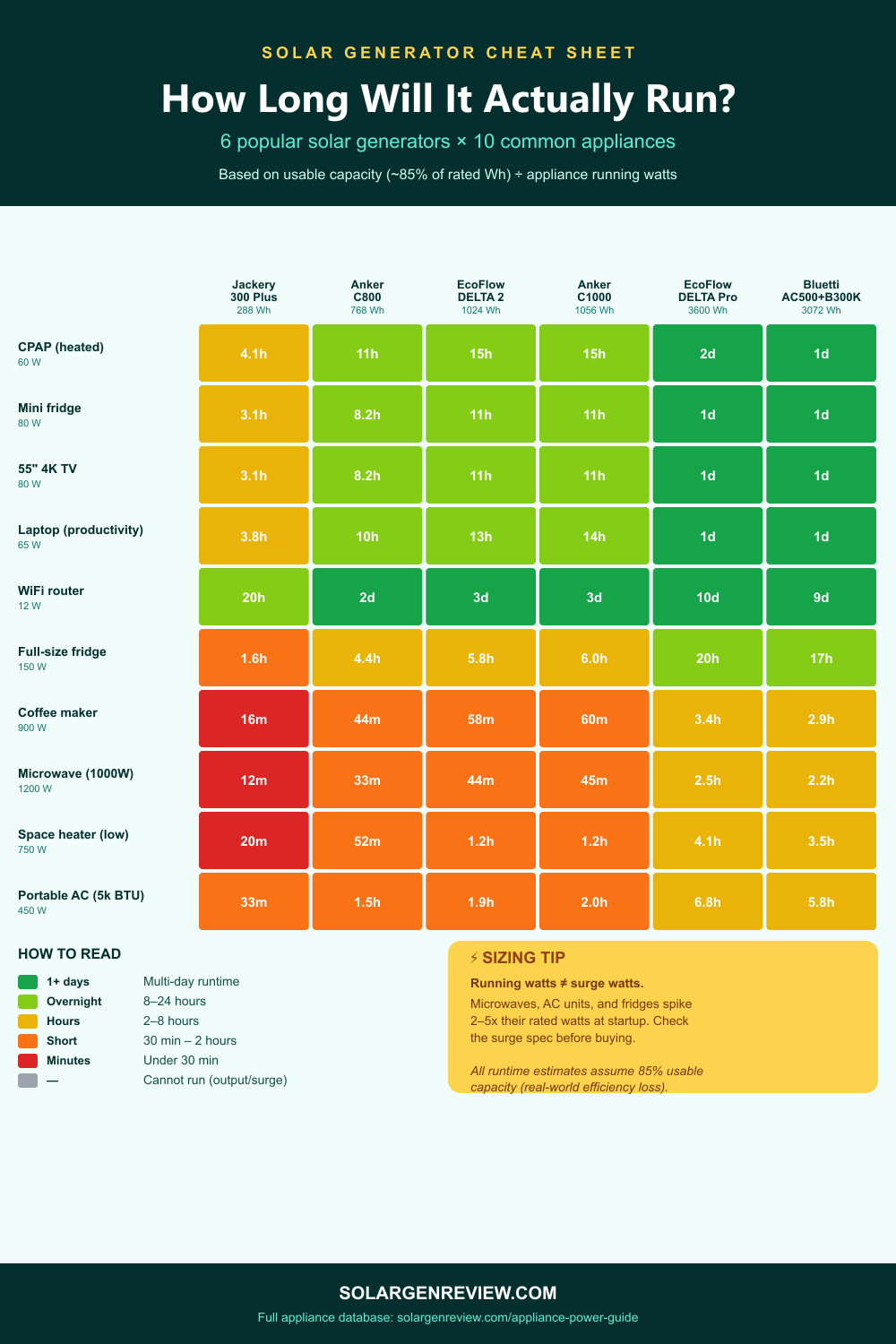
The math is unambiguous. Take a typical essential household load: refrigerator 150W average + LED lights 40W + phone and laptop charging 80W = 270W total. At that load:
- 1024Wh unit: 1024 × 0.85 ÷ 270 = 3.2 hours
- 2048Wh unit: 2048 × 0.85 ÷ 270 = 6.4 hours
- 3600Wh unit: 3600 × 0.85 ÷ 270 = 11.3 hours
- 6144Wh unit: 6144 × 0.85 ÷ 270 = 19.3 hours
Category 3+ hurricanes routinely cause 3-7 day outages in affected areas. During a 5-day outage at 11.3 hours per charge cycle, a 3600Wh unit needs to recharge roughly 10-11 times. With 1600W solar input and intermittent post-storm sun, that's achievable. With 500W solar input, it's not.
Add a medical device — CPAP at 50W, oxygen concentrator at 350W, insulin cooler at 20W — and runtime drops further. For households with medical needs, see our medical device solar generator guide for specific sizing.
Our Top Picks for Hurricane Season
| Product | Capacity | Output | Solar Input | Runtime at 270W | Price |
|---|---|---|---|---|---|
| EcoFlow DELTA Pro | 3600Wh | 3600W (7200W) | 1600W | 11.3 hrs | ~$2,699 |
| Bluetti Apex 300 | Expandable to 58kWh | 3000W (6000W) | 3000W | Scales with batteries | ~$3,999 |
| Jackery Explorer 2000 Plus | 2042Wh | 3000W (6000W) | 800W | 6.4 hrs | ~$1,499 |
| EcoFlow DELTA 2 | 1024Wh | 1800W (2700W) | 500W | 3.2 hrs | ~$999 |
| Anker SOLIX F3000 | 3072Wh | 3600W (6000W) | 1200W | 9.7 hrs | ~$2,299 |
Best Overall — EcoFlow DELTA Pro
The DELTA Pro has been the go-to hurricane preparedness generator for two years running, and nothing in the 2026 class displaces it for this specific use case. The combination of 3600Wh capacity, 3600W output, 7200W surge, and 1600W solar input is purpose-built for multi-day outage management.
- Capacity: 3600Wh LFP (expandable to 25kWh)
- Output: 3600W continuous, 7200W surge
- Solar input: 1600W max
- Battery cycles: 3500 to 80% capacity
- Smart Home Panel: Optional ($400-500 + installation)
For hurricane scenarios, the Smart Home Panel is worth serious consideration. When installed, the DELTA Pro connects directly to your breaker box. During an outage, selected circuits (refrigerator, lighting, medical device outlets) operate normally without extension cords, power strips, or manual switching. When the storm hits and you need to manage your load, the last thing you want is six extension cords across your floor in the dark.
The 7200W surge rating handles almost every residential load at startup: well pumps (1200-2000W surge), refrigerators (600W surge), sump pumps (1500W surge). For coastal and low-lying areas where sump pumps are critical during storm surge, this matters.
See our full EcoFlow DELTA Pro review for detailed performance testing.
Check price on AmazonBest Scalable System — Bluetti Apex 300
For households facing frequent multi-day outages — Gulf Coast, Atlantic coast, Caribbean — the Bluetti Apex 300 expandable to 58kWh is the only mainstream solution that genuinely handles 7-day outages without grid dependence. With enough B300 battery packs, you're running off a residential-scale storage system, not a portable generator.
- Output: 3000W (6000W surge)
- Native voltage: 240V + 120V
- Solar input: 3000W max
- Expandable to: 58kWh with B300 packs ($1,500 each)
- Price: ~$3,999 base
The 3000W solar input is the key hurricane spec. During the post-storm period, when you have 4-6 hours of good sun and are managing a week's worth of outage, 3000W of solar acceptance recovers 12,000-18,000Wh per day with an adequate panel array. That's enough to sustain significant loads indefinitely. For households with a permanent rooftop solar array, the Apex 300 can connect to it during outages — check compatibility with your specific array configuration.
Check price on AmazonBest Value for Heavy Loads — Jackery Explorer 2000 Plus
At $1,499 with 3000W output and 6000W surge, the Jackery 2000 Plus is the best value option for households that need high output without the DELTA Pro price. The 2042Wh capacity provides 6.4 hours at the standard 270W essential load — adequate for cycling loads through a night with moderate conservation.
- Capacity: 2042Wh LFP
- Output: 3000W (6000W surge)
- Solar input: 800W max
- Weight: 28kg
- Price: ~$1,499
The 800W solar input is the limiting factor for extended storm outages. Post-hurricane, if you get 5 hours of clearing weather, 800W input recovers roughly 700Wh — about a third of capacity. Managing a 5-day outage on this unit requires aggressive load cycling: run the fridge for 4 hours, turn it off for 2, lights on only when needed, devices charged in priority order. Workable but demanding. For hurricane preparedness with less management stress, the DELTA Pro's 1600W solar input is worth the extra $1,200.
Check price on AmazonMinimum Viable Option — EcoFlow DELTA 2
The DELTA 2 is the minimum viable solar generator for hurricane preparedness — and that's an important qualifier. At 1024Wh and 3.2 hours at 270W, it covers short outages and can extend to a full day with disciplined load management. For households in areas with Category 1-2 exposure where outages typically last 12-24 hours, it's a reasonable entry point.
For Category 3+ zones, 1024Wh is not adequate as your primary backup without a plan to supplement it: charging from a car (the DELTA 2 accepts car port input), adding an expansion battery ($499 for 1024Wh more), or treating it as a device-charging and lighting backup while the fridge manages on its own thermal mass.
A standard refrigerator holds safe temperature for 4 hours with the door closed after power loss. A full freezer holds for 48 hours. Knowing these numbers helps with load management when you only have 3.2 hours of continuous fridge power per charge cycle.
Check price on AmazonStrong Alternative — Anker SOLIX F3000
The Anker SOLIX F3000 at $2,299 is a compelling alternative to the EcoFlow DELTA Pro for hurricane prep. It matches the DELTA Pro on output (3600W continuous, 6000W surge), runs slightly less capacity (3072Wh vs 3600Wh), and accepts 1200W solar input vs 1600W. The $400 savings is meaningful, though the DELTA Pro's 400Wh extra capacity and faster solar recharge have real value in extended outage scenarios.
Runtime at 270W essential load: 3072 × 0.85 ÷ 270 = 9.7 hours — about 90 minutes less than the DELTA Pro. Over a 7-day outage, that difference compounds. For one-time storm prep where budget matters, the F3000 is a legitimate choice. For annual hurricane zone residents, the DELTA Pro's added capacity earns its price premium.
Check price on AmazonHurricane Prep Checklist
Before Storm Season
- Run a full discharge test on your generator before June 1 (Atlantic hurricane season start)
- Update firmware via the manufacturer app
- Charge to 80% for standby storage (not 100%)
- Confirm solar panel connections and cable condition
- Know your generator's runtime at your actual essential load — calculate it now, not during a storm
When a Storm Watch Is Issued
- Charge to 100% from grid power
- Fill any propane, gas, and water supplies
- Stage your extension cords and identify where each appliance will plug in
- Pre-charge all device batteries (phones, tablets, laptops, medical equipment)
During the Outage
- Run the refrigerator on a cycle: 4 hours on, 2 hours off — maintains safe temp while cutting consumption by 33%
- Charge devices in priority order (medical first, communication second, comfort last)
- Deploy solar panels as soon as weather clears
- Monitor battery level via app — set low-battery alerts at 20%
For the broader emergency preparedness picture, see our complete emergency preparedness solar generator guide.
Frequently Asked Questions
What size solar generator do I need for a hurricane?
At minimum, 3600Wh with 1600W solar input for serious hurricane preparedness. At a 270W essential load (fridge, lights, devices), a 3600Wh unit provides 11.3 hours per charge. With 1600W solar input recovering 1400Wh per day, you can sustain essential loads through a 7-day outage with load management. Units under 2048Wh are inadequate for Cat 3+ hurricane scenarios.
How long will a solar generator run during a power outage?
It depends on your load and capacity. At a typical essential load of 270W (fridge + lights + devices): 1024Wh lasts 3.2 hours, 2048Wh lasts 6.4 hours, 3600Wh lasts 11.3 hours. For overnight coverage, 3600Wh is the minimum. For multi-day hurricane outages, pair a 3600Wh+ unit with solar panels for daily recharge.
Can you use a solar generator during a hurricane?
Yes — solar generators are safe to operate indoors, unlike gas generators which produce carbon monoxide. During the storm itself, you run on stored battery. Solar recharging begins once the storm passes and skies clear. Store the solar panels indoors during high winds and deploy them after the storm.
Is the EcoFlow DELTA Pro good for hurricanes?
Yes — the DELTA Pro is specifically designed for extended outage scenarios. Its 3600Wh capacity covers 11+ hours of essential loads per charge, and the 1600W solar input enables full daily recharge when sun is available. The optional Smart Home Panel integrates with your breaker box for circuit-level backup without extension cords.
How much solar power do I need for hurricane backup?
For daily recharge capability during a multi-day hurricane outage, your solar input wattage × 5-6 peak sun hours should recover 50-75% of your battery capacity per day. For a 3600Wh unit, you need at least 400W of solar to recover meaningful capacity, and 1200-1600W for full daily recharge. The EcoFlow DELTA Pro's 1600W input accommodates a standard 4-panel 400W array.
Should I buy a solar generator or gas generator for hurricane prep?
Solar generators offer several advantages: safe for indoor use (no CO risk), no fuel storage required, silent operation, and no refueling trips during an active storm. Gas generators offer higher raw output (8,000-12,000W vs 3,600W max for solar) and faster refueling. For most households running essential loads only, solar generators are sufficient and significantly safer. See our solar vs gas generator comparison for a detailed breakdown.
What should I do with my solar generator before hurricane season?
Before June 1: run a full discharge test, update firmware via the manufacturer app, inspect all cables and panel connections, and store at 80% charge. When a storm watch is issued, charge to 100% from grid power. Stage extension cords, pre-charge all device batteries, and know your exact runtime at your planned essential load before the storm hits.
Can a solar generator run a window AC unit during a hurricane?
Yes, with the right unit. A window AC draws 1000-1500W. The EcoFlow DELTA Pro (3600W output) can run a window AC unit but capacity depletes quickly: 3600Wh ÷ 1250W average = 2.9 hours on AC alone. Running AC during a hurricane outage is a luxury load — prioritize fridge, medical devices, and lighting. AC is feasible only with large capacity (6000Wh+) and active solar recharging.